









The TDs Land at Anzio
Дата: 06.05.2019 18:24:20
The_Chieftain:  In the archives of the Tank Destroyer Branch is an
after-action assessment written by VI Corps’ artillery section,
entitled “Anti-Tank Defense of Anzio Beachhead.” It was not unusual
for “Anti-Tank Defense” to be placed under the artillery department
of a large unit, and certainly the Germans put some pretty heavy
armor into trying to repel the Anzio landing forces. 75 years ago,
the two sides were still locked in something of a stalemate, after
nearly three months of fighting. Combined with some of the unit
AARs, the following can be written.
In the archives of the Tank Destroyer Branch is an
after-action assessment written by VI Corps’ artillery section,
entitled “Anti-Tank Defense of Anzio Beachhead.” It was not unusual
for “Anti-Tank Defense” to be placed under the artillery department
of a large unit, and certainly the Germans put some pretty heavy
armor into trying to repel the Anzio landing forces. 75 years ago,
the two sides were still locked in something of a stalemate, after
nearly three months of fighting. Combined with some of the unit
AARs, the following can be written. VI CorpsThe planning for
Operation Shingle began in early January of 1944. At the time, VI
Corps was in the vicinity of Venafro, before it was pulled back to
direct its attentions towards Anzio.Initial planning concluded that
the objectives laid out for G-3 near the beach-head were not well
suited to anti-tank defense. As a result, the line was extended out
on the left flank to the Moletta river: The river made a better
natural obstacle, and there was a reasonable road network to supply
forces there.From there, co-ordination had to be made between the
US and British units, to ensure no gaps developed, and with the
engineers, to figure out what to demolish, where to lay mines, and
where to lay roadblocks.The next question was to ensure that
sufficient AT capability was provided to the units, and that their
ship load plans included sufficient AT capability offloaded early
in the landings. The Corps decided that an 80-20 split of HE with
AP would be appropriate: The ratio had been deemed proven
satisfactory in the past, they saw no reason to change it now.Other
factors for planning included working with the units to ensure that
likely avenues of approach were covered, and creating a liaison
system.Lessons started being learned before the first ship was
loaded. Firstly, that a Division or Corps AT section needed to be
included in any planning group right the way through the process,
from beginning of planning to completion. Secondly, that a
dedicated AT officer needs to work with the G-3, 4 and 2
(Operations, Supply and Intelligence) in order to advise them of
the capabilities and limitations of TDs and other AT means, and to
assist them in their planning estimates.A third lesson was that AT
units were not being promptly informed of changes or modifications
in plans, meaning that they had less time to change their
disposition. Also, there seemed to be too little cross-talk between
the subordinate units, so there was incomplete co-ordination
between them.And that was just the planning. VI Corps was in a
better position than some, in that it created an Anti-tank
subsection under General Ramey, which consisted of him, his aid, a
“good TD major” and an expert typist. The War Dept officially did
not authorize such a section, so it was a local creation.The
landings at Anzio started 22 January. The 601st TD Bn,
attached to 3rd Division, landed in the first assault wave
before dawn, the 83 vehicles and 373 men split amongst ten ships.
The 601st, equipped with M10s, was used to being attached to the
3rd. A company was split up one platoon per regiment, and landed
alongside one platoon per regiment of tanks from 751st Tank
Battalion. The rest landed during the day, the TDs from LSTs, the
tanks from LCTs. No particular resistance was identified. The
601st was the crack US anti-tank unit, converted from
the pre-war 1st Infantry Division Provisional Anti-tank
battalion, and starting right in the thick of things with the North
Africa landings, fighting at Kasserine Pass and El Guettar, the
latter being likely the highlight of US tank destroyer operations
throughout the war.
VI CorpsThe planning for
Operation Shingle began in early January of 1944. At the time, VI
Corps was in the vicinity of Venafro, before it was pulled back to
direct its attentions towards Anzio.Initial planning concluded that
the objectives laid out for G-3 near the beach-head were not well
suited to anti-tank defense. As a result, the line was extended out
on the left flank to the Moletta river: The river made a better
natural obstacle, and there was a reasonable road network to supply
forces there.From there, co-ordination had to be made between the
US and British units, to ensure no gaps developed, and with the
engineers, to figure out what to demolish, where to lay mines, and
where to lay roadblocks.The next question was to ensure that
sufficient AT capability was provided to the units, and that their
ship load plans included sufficient AT capability offloaded early
in the landings. The Corps decided that an 80-20 split of HE with
AP would be appropriate: The ratio had been deemed proven
satisfactory in the past, they saw no reason to change it now.Other
factors for planning included working with the units to ensure that
likely avenues of approach were covered, and creating a liaison
system.Lessons started being learned before the first ship was
loaded. Firstly, that a Division or Corps AT section needed to be
included in any planning group right the way through the process,
from beginning of planning to completion. Secondly, that a
dedicated AT officer needs to work with the G-3, 4 and 2
(Operations, Supply and Intelligence) in order to advise them of
the capabilities and limitations of TDs and other AT means, and to
assist them in their planning estimates.A third lesson was that AT
units were not being promptly informed of changes or modifications
in plans, meaning that they had less time to change their
disposition. Also, there seemed to be too little cross-talk between
the subordinate units, so there was incomplete co-ordination
between them.And that was just the planning. VI Corps was in a
better position than some, in that it created an Anti-tank
subsection under General Ramey, which consisted of him, his aid, a
“good TD major” and an expert typist. The War Dept officially did
not authorize such a section, so it was a local creation.The
landings at Anzio started 22 January. The 601st TD Bn,
attached to 3rd Division, landed in the first assault wave
before dawn, the 83 vehicles and 373 men split amongst ten ships.
The 601st, equipped with M10s, was used to being attached to the
3rd. A company was split up one platoon per regiment, and landed
alongside one platoon per regiment of tanks from 751st Tank
Battalion. The rest landed during the day, the TDs from LSTs, the
tanks from LCTs. No particular resistance was identified. The
601st was the crack US anti-tank unit, converted from
the pre-war 1st Infantry Division Provisional Anti-tank
battalion, and starting right in the thick of things with the North
Africa landings, fighting at Kasserine Pass and El Guettar, the
latter being likely the highlight of US tank destroyer operations
throughout the war.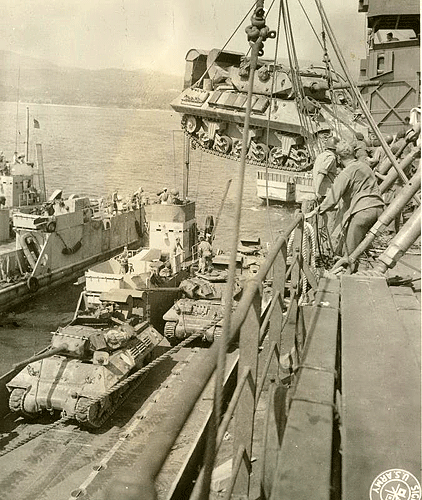 M10s of the 601st being loaded onto landing
craft. This photo actually from Operation Dragoon, but gets
the point across.The battalion commander of the 601st was
appointed as the Division’s AT officer, and the company commanders
often became regimental AT officers. Results varied: One regiment
gave the AT officer a mission and let him do it. Another regiment
micromanaged the AT positions, and simply used the AT officer as an
orders conduit.The British 81st Anti-Tank Regiment was held in
floating reserve, ready to offload as needed. Given that the report
indicates that the 601st took much of the day just organizing
after landing, it may be questioned just how rapidly the
81st could be landed. On the plus side, the 81st was
equipped with towed 6pr and 17pr guns, capable of being offloaded
quickly. On the downside, the 81stwas equipped with towed 6pr and
17pr guns…Things were quiet the first few days. The only reported
action in the 601st history was the destruction of an
unidentified tank and a machinegun nest. The Germans made their
first major push back on the 26th, against the British
1st Division on the Allied left (Northern) flank around
Carroceto, including an estimated 20 tanks. The 894th TD
Battalion, a Corps asset, was being offloaded that day, and two
companies were immediately dispatched in support. The 894th, also a
veteran unit of Kasserine Pass, was also an M10-equipped unit by
this time. The line held.
M10s of the 601st being loaded onto landing
craft. This photo actually from Operation Dragoon, but gets
the point across.The battalion commander of the 601st was
appointed as the Division’s AT officer, and the company commanders
often became regimental AT officers. Results varied: One regiment
gave the AT officer a mission and let him do it. Another regiment
micromanaged the AT positions, and simply used the AT officer as an
orders conduit.The British 81st Anti-Tank Regiment was held in
floating reserve, ready to offload as needed. Given that the report
indicates that the 601st took much of the day just organizing
after landing, it may be questioned just how rapidly the
81st could be landed. On the plus side, the 81st was
equipped with towed 6pr and 17pr guns, capable of being offloaded
quickly. On the downside, the 81stwas equipped with towed 6pr and
17pr guns…Things were quiet the first few days. The only reported
action in the 601st history was the destruction of an
unidentified tank and a machinegun nest. The Germans made their
first major push back on the 26th, against the British
1st Division on the Allied left (Northern) flank around
Carroceto, including an estimated 20 tanks. The 894th TD
Battalion, a Corps asset, was being offloaded that day, and two
companies were immediately dispatched in support. The 894th, also a
veteran unit of Kasserine Pass, was also an M10-equipped unit by
this time. The line held.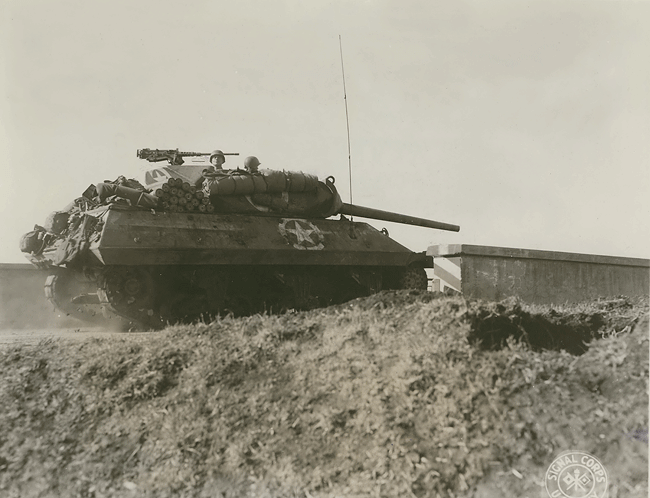 Another M10 of the 601st, possibly at
a bridge or The Overpass (More on that next article)The
27th was a good day for the 601st. 2nd Platoon of B
company had some long-range shooting practice, knocking out two
“7.5cm Assault Gun PaK 40” (It is disappointing that we cannot tell
from the American side if this was a StuG, Marder or one of the
newly arrived Jagdpanzer IVs) at 1,000 and 1,500 yards. The first
took three rounds HE and three APC, the second 5 HE and 3 APC.
3rd platoon went another route, and at about 300 yards, fired
through both walls of a house to knock out a tank hiding behind it.
Then, at some unusually long sightline, knocked out another 7.5cm
assault gun at 1,700 yards, and then a 20mm flak gun. The next day,
Third Herd added another tank and armored car to their score. The
infantry then started an attack, and the 601st ended up
playing close support, a role it took on rather more than most.
894th played a similar role for the British.As the attack
progressed, the Germans started showing up in strength. The
30th 2/B/601st kill a PzIII and three “77mm” AT guns at
50, 500 and 800 yards range. The 31st, though, started getting busy
in the area around the Mussolini Canal.1/A/601st claimed two
PzIV and an armored car with 6 rounds APC and 4 HE. They then took
on 6 MG nests and a bunch of personnel firing 90 HE rounds. Not to
be outdone, 3rd Platoon B added a Tiger to its kill claim,
with 3 rounds in the turret at 1,000 yards. 3/C was used in an
indirect fire role, the FO claimed their 81 rounds killed three or
four MG nests. Even the M8 armored cars got into the action, firing
Canister at infantry at 200 yards. In return, the 601st lost
two M10s (defined as “cannot be repaired within 24 hours), both
from B company: One to enemy fire, and one a mine strike. On the
other hand, the British and 894th were embroiled in bitter
fighting. Within a week of the off on the 29th, C/894th was
down to half strength in men and equipment, and needed to be
replaced by B company. It wasn’t without vengeance, the a TD under
a Sgt Dobson claimed to have killed the first of a number of Tigers
which would meet their end in Anzio.
Another M10 of the 601st, possibly at
a bridge or The Overpass (More on that next article)The
27th was a good day for the 601st. 2nd Platoon of B
company had some long-range shooting practice, knocking out two
“7.5cm Assault Gun PaK 40” (It is disappointing that we cannot tell
from the American side if this was a StuG, Marder or one of the
newly arrived Jagdpanzer IVs) at 1,000 and 1,500 yards. The first
took three rounds HE and three APC, the second 5 HE and 3 APC.
3rd platoon went another route, and at about 300 yards, fired
through both walls of a house to knock out a tank hiding behind it.
Then, at some unusually long sightline, knocked out another 7.5cm
assault gun at 1,700 yards, and then a 20mm flak gun. The next day,
Third Herd added another tank and armored car to their score. The
infantry then started an attack, and the 601st ended up
playing close support, a role it took on rather more than most.
894th played a similar role for the British.As the attack
progressed, the Germans started showing up in strength. The
30th 2/B/601st kill a PzIII and three “77mm” AT guns at
50, 500 and 800 yards range. The 31st, though, started getting busy
in the area around the Mussolini Canal.1/A/601st claimed two
PzIV and an armored car with 6 rounds APC and 4 HE. They then took
on 6 MG nests and a bunch of personnel firing 90 HE rounds. Not to
be outdone, 3rd Platoon B added a Tiger to its kill claim,
with 3 rounds in the turret at 1,000 yards. 3/C was used in an
indirect fire role, the FO claimed their 81 rounds killed three or
four MG nests. Even the M8 armored cars got into the action, firing
Canister at infantry at 200 yards. In return, the 601st lost
two M10s (defined as “cannot be repaired within 24 hours), both
from B company: One to enemy fire, and one a mine strike. On the
other hand, the British and 894th were embroiled in bitter
fighting. Within a week of the off on the 29th, C/894th was
down to half strength in men and equipment, and needed to be
replaced by B company. It wasn’t without vengeance, the a TD under
a Sgt Dobson claimed to have killed the first of a number of Tigers
which would meet their end in Anzio.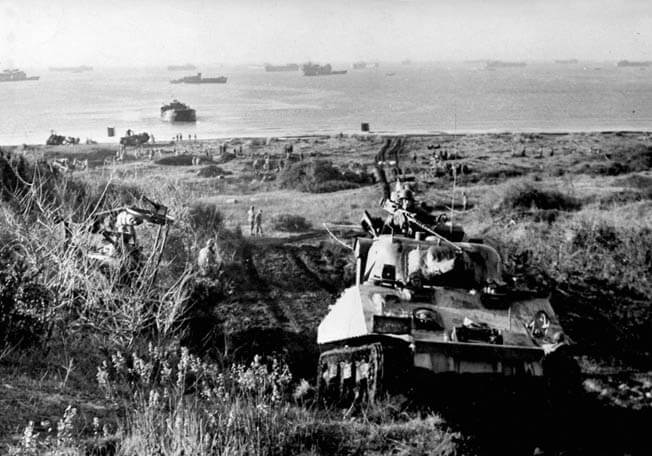 An M4 heads inland from one of the
Anzio beachesThe same day, the 45th Infantry Division landed
along with the M10s of the 645th. The allied attacks began to peter
out by the beginning of February, by the 4th it was made
official: Assume the defensive, except for local
counter-attacks.The 645th was used as artillery for the first
two weeks, particularly for harassing fires. The unit history
states that the night of 7/8 Feb was “very quiet”, with B company
only firing 778 rounds. It is worth observing that in the
after-action reports for Anzio, the TDs reported that they would
fire between 2,500 to 3,500 rounds per tube before barrel wear
became an issue, and the guns (and sometimes the trunnions) needed
to be replaced. But, replaced they were in the field, and no
limitations were placed on the use of the TDs as artillery out of
concerns of wearing out the tubes.The 645th was soon detached
from the 45th, though, and sent to relieve the battered 894th. The
relief was completed by the 16th, just in time to form a reception
committee for Operation Fischfang, a determined German effort to
push the allies back into the sea. The British, in particular, took
it on the chin. In the next part of this series, we follow the
defense.
An M4 heads inland from one of the
Anzio beachesThe same day, the 45th Infantry Division landed
along with the M10s of the 645th. The allied attacks began to peter
out by the beginning of February, by the 4th it was made
official: Assume the defensive, except for local
counter-attacks.The 645th was used as artillery for the first
two weeks, particularly for harassing fires. The unit history
states that the night of 7/8 Feb was “very quiet”, with B company
only firing 778 rounds. It is worth observing that in the
after-action reports for Anzio, the TDs reported that they would
fire between 2,500 to 3,500 rounds per tube before barrel wear
became an issue, and the guns (and sometimes the trunnions) needed
to be replaced. But, replaced they were in the field, and no
limitations were placed on the use of the TDs as artillery out of
concerns of wearing out the tubes.The 645th was soon detached
from the 45th, though, and sent to relieve the battered 894th. The
relief was completed by the 16th, just in time to form a reception
committee for Operation Fischfang, a determined German effort to
push the allies back into the sea. The British, in particular, took
it on the chin. In the next part of this series, we follow the
defense.
In the archives of the Tank Destroyer Branch is an
after-action assessment written by VI Corps’ artillery section,
entitled “Anti-Tank Defense of Anzio Beachhead.” It was not unusual
for “Anti-Tank Defense” to be placed under the artillery department
of a large unit, and certainly the Germans put some pretty heavy
armor into trying to repel the Anzio landing forces. 75 years ago,
the two sides were still locked in something of a stalemate, after
nearly three months of fighting. Combined with some of the unit
AARs, the following can be written.VI CorpsThe planning for
Operation Shingle began in early January of 1944. At the time, VI
Corps was in the vicinity of Venafro, before it was pulled back to
direct its attentions towards Anzio.Initial planning concluded that
the objectives laid out for G-3 near the beach-head were not well
suited to anti-tank defense. As a result, the line was extended out
on the left flank to the Moletta river: The river made a better
natural obstacle, and there was a reasonable road network to supply
forces there.From there, co-ordination had to be made between the
US and British units, to ensure no gaps developed, and with the
engineers, to figure out what to demolish, where to lay mines, and
where to lay roadblocks.The next question was to ensure that
sufficient AT capability was provided to the units, and that their
ship load plans included sufficient AT capability offloaded early
in the landings. The Corps decided that an 80-20 split of HE with
AP would be appropriate: The ratio had been deemed proven
satisfactory in the past, they saw no reason to change it now.Other
factors for planning included working with the units to ensure that
likely avenues of approach were covered, and creating a liaison
system.Lessons started being learned before the first ship was
loaded. Firstly, that a Division or Corps AT section needed to be
included in any planning group right the way through the process,
from beginning of planning to completion. Secondly, that a
dedicated AT officer needs to work with the G-3, 4 and 2
(Operations, Supply and Intelligence) in order to advise them of
the capabilities and limitations of TDs and other AT means, and to
assist them in their planning estimates.A third lesson was that AT
units were not being promptly informed of changes or modifications
in plans, meaning that they had less time to change their
disposition. Also, there seemed to be too little cross-talk between
the subordinate units, so there was incomplete co-ordination
between them.And that was just the planning. VI Corps was in a
better position than some, in that it created an Anti-tank
subsection under General Ramey, which consisted of him, his aid, a
“good TD major” and an expert typist. The War Dept officially did
not authorize such a section, so it was a local creation.The
landings at Anzio started 22 January. The 601st TD Bn,
attached to 3rd Division, landed in the first assault wave
before dawn, the 83 vehicles and 373 men split amongst ten ships.
The 601st, equipped with M10s, was used to being attached to the
3rd. A company was split up one platoon per regiment, and landed
alongside one platoon per regiment of tanks from 751st Tank
Battalion. The rest landed during the day, the TDs from LSTs, the
tanks from LCTs. No particular resistance was identified. The
601st was the crack US anti-tank unit, converted from
the pre-war 1st Infantry Division Provisional Anti-tank
battalion, and starting right in the thick of things with the North
Africa landings, fighting at Kasserine Pass and El Guettar, the
latter being likely the highlight of US tank destroyer operations
throughout the war.M10s of the 601st being loaded onto landing
craft. This photo actually from Operation Dragoon, but gets
the point across.The battalion commander of the 601st was
appointed as the Division’s AT officer, and the company commanders
often became regimental AT officers. Results varied: One regiment
gave the AT officer a mission and let him do it. Another regiment
micromanaged the AT positions, and simply used the AT officer as an
orders conduit.The British 81st Anti-Tank Regiment was held in
floating reserve, ready to offload as needed. Given that the report
indicates that the 601st took much of the day just organizing
after landing, it may be questioned just how rapidly the
81st could be landed. On the plus side, the 81st was
equipped with towed 6pr and 17pr guns, capable of being offloaded
quickly. On the downside, the 81stwas equipped with towed 6pr and
17pr guns…Things were quiet the first few days. The only reported
action in the 601st history was the destruction of an
unidentified tank and a machinegun nest. The Germans made their
first major push back on the 26th, against the British
1st Division on the Allied left (Northern) flank around
Carroceto, including an estimated 20 tanks. The 894th TD
Battalion, a Corps asset, was being offloaded that day, and two
companies were immediately dispatched in support. The 894th, also a
veteran unit of Kasserine Pass, was also an M10-equipped unit by
this time. The line held.Another M10 of the 601st, possibly at
a bridge or The Overpass (More on that next article)The
27th was a good day for the 601st. 2nd Platoon of B
company had some long-range shooting practice, knocking out two
“7.5cm Assault Gun PaK 40” (It is disappointing that we cannot tell
from the American side if this was a StuG, Marder or one of the
newly arrived Jagdpanzer IVs) at 1,000 and 1,500 yards. The first
took three rounds HE and three APC, the second 5 HE and 3 APC.
3rd platoon went another route, and at about 300 yards, fired
through both walls of a house to knock out a tank hiding behind it.
Then, at some unusually long sightline, knocked out another 7.5cm
assault gun at 1,700 yards, and then a 20mm flak gun. The next day,
Third Herd added another tank and armored car to their score. The
infantry then started an attack, and the 601st ended up
playing close support, a role it took on rather more than most.
894th played a similar role for the British.As the attack
progressed, the Germans started showing up in strength. The
30th 2/B/601st kill a PzIII and three “77mm” AT guns at
50, 500 and 800 yards range. The 31st, though, started getting busy
in the area around the Mussolini Canal.1/A/601st claimed two
PzIV and an armored car with 6 rounds APC and 4 HE. They then took
on 6 MG nests and a bunch of personnel firing 90 HE rounds. Not to
be outdone, 3rd Platoon B added a Tiger to its kill claim,
with 3 rounds in the turret at 1,000 yards. 3/C was used in an
indirect fire role, the FO claimed their 81 rounds killed three or
four MG nests. Even the M8 armored cars got into the action, firing
Canister at infantry at 200 yards. In return, the 601st lost
two M10s (defined as “cannot be repaired within 24 hours), both
from B company: One to enemy fire, and one a mine strike. On the
other hand, the British and 894th were embroiled in bitter
fighting. Within a week of the off on the 29th, C/894th was
down to half strength in men and equipment, and needed to be
replaced by B company. It wasn’t without vengeance, the a TD under
a Sgt Dobson claimed to have killed the first of a number of Tigers
which would meet their end in Anzio.An M4 heads inland from one of the
Anzio beachesThe same day, the 45th Infantry Division landed
along with the M10s of the 645th. The allied attacks began to peter
out by the beginning of February, by the 4th it was made
official: Assume the defensive, except for local
counter-attacks.The 645th was used as artillery for the first
two weeks, particularly for harassing fires. The unit history
states that the night of 7/8 Feb was “very quiet”, with B company
only firing 778 rounds. It is worth observing that in the
after-action reports for Anzio, the TDs reported that they would
fire between 2,500 to 3,500 rounds per tube before barrel wear
became an issue, and the guns (and sometimes the trunnions) needed
to be replaced. But, replaced they were in the field, and no
limitations were placed on the use of the TDs as artillery out of
concerns of wearing out the tubes.The 645th was soon detached
from the 45th, though, and sent to relieve the battered 894th. The
relief was completed by the 16th, just in time to form a reception
committee for Operation Fischfang, a determined German effort to
push the allies back into the sea. The British, in particular, took
it on the chin. In the next part of this series, we follow the
defense.The TDs Land at Anzio