






From the Mouths of Babes
Дата: 17.01.2015 01:13:23
The_Chieftain:  We’re going to stay in the North African Theater of
Operations for this one, with a couple of commentaries from
American Lieutenants on the matter of Tank Destroyers. Lieutenants
are, of course, the whipping boys of the Army. How many movies have
you seen that the lieutenant is actually competent and reliable? It
seems that always they are lost, confused, overeager, detached from
reality, and frequently incapacitated while requiring the grizzled
old sergeant to fix the situation. Of course, the reality is that
they’re just as good as anyone else with similar experience levels,
and their observations are not without merit. I used to be one
myself, after all.
We’re going to stay in the North African Theater of
Operations for this one, with a couple of commentaries from
American Lieutenants on the matter of Tank Destroyers. Lieutenants
are, of course, the whipping boys of the Army. How many movies have
you seen that the lieutenant is actually competent and reliable? It
seems that always they are lost, confused, overeager, detached from
reality, and frequently incapacitated while requiring the grizzled
old sergeant to fix the situation. Of course, the reality is that
they’re just as good as anyone else with similar experience levels,
and their observations are not without merit. I used to be one
myself, after all.  Insignia of the 40th Infantry Division. Known as
"Twelve Lieutenants Pointing North" We’ll start off with a fairly
straightforward summary of an interview with a Lt. Louis A Romani,
as found in the Tank Destroyer Board archives. Quote follows:
1.
General
This officer served as an enlisted man and as a platoon leader with
the 701st TD Battalion in the African and Italian Campaigns.
He received his training at Fort Knox, Kentucky for six months and
went overseas in May 1942, where he remained for thirty-four
months. He received a battlefield promotion during the African
Campaign. The 701st TD Battalion was equipped with M-3s and
M-10s.
2.
Employment of the Battalion.
The battalion was primarily used on secondary missions as
reinforcing artillery and, as such, fired harassing fire TOT. They
were also used against pillboxes, fortified houses and in close
support of infantry with both direct and indirect fire.
3.
Close support of infantry and tanks.
As a rule, one platoon of TDs was attached to each infantry
company. In these cases, the platoon usually remained in a position
in readiness where indirect fire positions were prepared. When
targets were located by the infantry, they moved forward to
prepared positions with hull defilade and took the targets under
fire. After completing firing, they again returned to the indirect
fire positions.
The unit felt that the knocking out of AT guns was not a mission
for TDs and therefore, would not usually engage them, but left them
for the tanks to dispose of.
4.
Primary Mission.
In operating against enemy armor, wherever it was possible,
destroyers were sited in depth with two guns in the center and one
on each side, the latter in flanking fire positions.
It was found that the M-10 was very effective against Mark V and
Mark VI tanks and the Ferdinand self-propelled gun, up to a range
of 1,000 yards, with the best range between 400 and 800 yards.
This unit trained their gunners to shoot just short of the tank on
rocky ground so that the round would bounce into the tank from
underneath.
5
Pillboxes.
It was found that APC ammunition was very effective against
concrete and hardened steel pillboxes. These were taken under fire
at ranges from 500 to 800 yards and on the average of ten to
fifteen rounds were sufficient to reduce the pillbox.
Normal procedure was to assign two guns to a pillbox from positions
which were not close together and control them by radio. Both guns
then fired on a predetermined point which usually was the center of
the pillbox.
6
Indirect fire
Insignia of the 40th Infantry Division. Known as
"Twelve Lieutenants Pointing North" We’ll start off with a fairly
straightforward summary of an interview with a Lt. Louis A Romani,
as found in the Tank Destroyer Board archives. Quote follows:
1.
General
This officer served as an enlisted man and as a platoon leader with
the 701st TD Battalion in the African and Italian Campaigns.
He received his training at Fort Knox, Kentucky for six months and
went overseas in May 1942, where he remained for thirty-four
months. He received a battlefield promotion during the African
Campaign. The 701st TD Battalion was equipped with M-3s and
M-10s.
2.
Employment of the Battalion.
The battalion was primarily used on secondary missions as
reinforcing artillery and, as such, fired harassing fire TOT. They
were also used against pillboxes, fortified houses and in close
support of infantry with both direct and indirect fire.
3.
Close support of infantry and tanks.
As a rule, one platoon of TDs was attached to each infantry
company. In these cases, the platoon usually remained in a position
in readiness where indirect fire positions were prepared. When
targets were located by the infantry, they moved forward to
prepared positions with hull defilade and took the targets under
fire. After completing firing, they again returned to the indirect
fire positions.
The unit felt that the knocking out of AT guns was not a mission
for TDs and therefore, would not usually engage them, but left them
for the tanks to dispose of.
4.
Primary Mission.
In operating against enemy armor, wherever it was possible,
destroyers were sited in depth with two guns in the center and one
on each side, the latter in flanking fire positions.
It was found that the M-10 was very effective against Mark V and
Mark VI tanks and the Ferdinand self-propelled gun, up to a range
of 1,000 yards, with the best range between 400 and 800 yards.
This unit trained their gunners to shoot just short of the tank on
rocky ground so that the round would bounce into the tank from
underneath.
5
Pillboxes.
It was found that APC ammunition was very effective against
concrete and hardened steel pillboxes. These were taken under fire
at ranges from 500 to 800 yards and on the average of ten to
fifteen rounds were sufficient to reduce the pillbox.
Normal procedure was to assign two guns to a pillbox from positions
which were not close together and control them by radio. Both guns
then fired on a predetermined point which usually was the center of
the pillbox.
6
Indirect fire 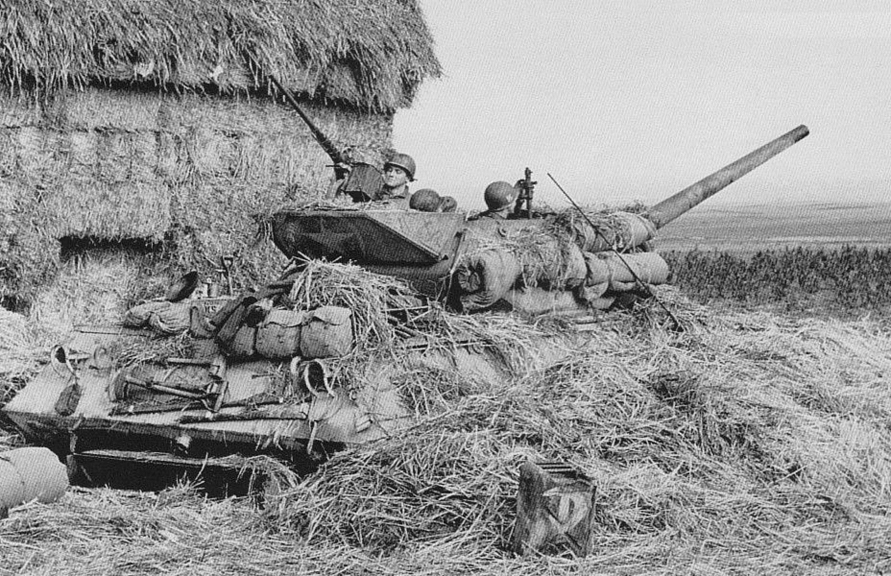 In indirect fire, this unit was employed both by company and by
platoon. When employed as a platoon they operated their own FDC.
When operating as a company, the artillery sometimes operated the
FDC and at other times it was operated by company headquarters.
Most of their missions were TOT harassing fires.
6.
(Yes, the document miscounted). Night Fire.
The infantry usually designated, during the day, the target to be
engaged at night and in many cases this allowed eight hours for
reconnaissance and the location of positions and determination of
range. At night the TDs (usually two guns) occupied predetermined
positions, kept their motors running and notified the infantry when
they were in position. The infantry then illuminated the target by
flares and the TDs fired as many rounds as possible very rapidly
and then withdrew before the enemy artillery came down on their
positions. In at least one case, sixty rounds were fired by one gun
in this manner.
7
Against personnel.
In some instances, TDs were used in direct fire against personnel
and it was found that best results were obtained by using HE with
fuse delay and aiming just short of the infantry which caused an
air-burst about ten feet over the enemy.
8.
Replacements.
Replacements were received from all branches of the service, some
coming from TDRTC. These replacements were better trained and more
efficient than those received from other branches.
9.
Battalion Commander
Battalion commander and his staff served to co-ordinate supply and
as a special staff officer on the staff of the divisional
commander. 10.
Reconnaissance Personnel.
Reconnaissance personnel did little or no reconnaissance for the
unit due to the static situation. They were used mainly with
infantry as security detachments and at times held a part of the
front line.
11. Security
This battalion was streamlined and the security personnel were
practically eliminated. Those that were left were used as
replacements in the gun companies.
When TDs were operating with infantry of (sic) tank units security
was provided for them by such units, but it was found by this
officer that unless the TDs were actually needed by some other
unit, no consideration was given to local security of TDs.
12
Relief
Due to the static situation, a mobile reserve was usually held out;
therefore, the TDs actually in combat were able to be withdrawn by
platoon or by company and given three or four days about once a
month for maintenance, rest and training in a rest area.
13
Mechanical Failures
None 14
Spare parts
There was little call for replacement of spare parts in the
vehicles of this battalion. Divisional ordnance had approximately
one company in excess destroyers and as they were in need for
replacements, the destroyer was replaced by another entire vehicle.
15
Personal Belongings
Personal belongings were kept in a pool in the battalion area under
a guard from their own unit.
16
Ammunition load.
Ammunition was loaded on the decks of the destroyers and in every
available space so that there was no certain load. Approximately
one third of the ammunition carried was AP or APC (Whatever was
available) and two-thirds HE.
17
Communications.
The communications within this officer’s unit are described as
fair; within the platoon they were good. While the company
headquarters could reach the platoon, the platoon could not reach
the company. It was found that while the SCR 610 worked very well
when tested, the range was not over 1,000 yards after moving over
rough terrain.
When working with the Infantry, this platoon was furnished with the
SCR 300 for communication with the supporting unit.
In static positions, wire was laid to the gun and the remote
control unit was used.
In indirect fire positions, wire was laid to the FDC.
Transcript ends. Now, I’m not sure that having to knock out enemy
armour by ricocheting from the ground is the ideal solution to a
problem, but I guess one cannot argue with success. This probably
should be taken as a reminder that the German cats were not a
surprise to the US Army when they were finally encountered in
France: However, the lads waiting in the UK to cross the Channel
simply knew “Our colleagues in NATOUSA have met the Panther and it
seems we can deal with it when it shows up.” It seems reasonable to
conclude that they weren’t aware of the more detailed reports
coming in from Fifth Army, which I’ll get into in a future article.
A memo cover sheet was found next to the above interview summary,
and as it covered the same area and time period, I’ll digress to
it. It may not have been by a Lieutenant. Transcript begins:
Col RCM (Ray Calhoun Montgomery, TD Board President)
As a result of interview with an officer who was with the
1st Inf. Div. and who saw action from Nov 10, 1942 to 10 March
1944 at Oran, El Guettar, Sicily, Salerno, Cassino, and Anzio
Beachhead, following items of interest are passed on to TD Board
members:
1.
In Italy, an effective team composed of engineers, infantry and one
tank destroyer has been used against German pill boxes. A small
patrol, perhaps 1 platoon of engineers and
1 platoon of infantry,
moves forward at night toward enemy
pill box. Engineers make
a path thru mines. Arriving at a
point where aerial photograph indicates probable
location of pill-box, patrol listens
in darkness to hear enemy personnel talking, or
in some other way determines the exact location
of pill-box. Spot is then marked by a stake, a chalked
cross, or by reference to some rock or tree. Patrol then
retires to base. Next day the infantry platoon leader
guides an M10
along the path cleared thru the minefield. Infantry- man
rides in M10fighting compartment with the TD crew.
Arriving within 75 yds. of the pill-box, camouflaged
pill-box cannot be
seen by the M10 crew.But the infantryman
nevertheless sights the gun directly on it, using asreference the
stake or rock or chalkmark he made the night before. Pill-box is
then destroyed by one shot fired point blank at 75 yd.
range. Significance: Teamwork.
2.
In Tunisia, an infantry unit was dug in behind
a hill and saw about 50 German tanks attacking them.
Friendly artillery was laying indirect fire on the tanks
but failed to stop them. Infantry then looked back and
saw M10s approaching from the rear. But the
infantry had not been oriented as to existence
of M10s and thought that these were
some strange variety of German or Italian tanks.
They seemed to be completely surrounded
by enemy tanks. Then the M10s took firing positions
and amazed theinfantry by promptly destroying eleven
enemy tanks and causing remainder to immediate withdraw.
Interviewed officer was wounded at this action.
He states that in subsequent similar actions,
infantry not only recognized the M10s but broke into cheers at
their approach. Significance, however is that troops must
be taught to recognize friendly units before the battle,
and not during it.
3. Interviewed infantry officer tells of
effective use made of phosphorous shells fired from
4.2 inch mortars. States that shellswere
fired by chemical Bn and had the effect of
incendiary bombs, burning everything
they touched. States that captured Germans had skin burns
from these phosphorous shells, and seemed to have
been demoralised by them.
In indirect fire, this unit was employed both by company and by
platoon. When employed as a platoon they operated their own FDC.
When operating as a company, the artillery sometimes operated the
FDC and at other times it was operated by company headquarters.
Most of their missions were TOT harassing fires.
6.
(Yes, the document miscounted). Night Fire.
The infantry usually designated, during the day, the target to be
engaged at night and in many cases this allowed eight hours for
reconnaissance and the location of positions and determination of
range. At night the TDs (usually two guns) occupied predetermined
positions, kept their motors running and notified the infantry when
they were in position. The infantry then illuminated the target by
flares and the TDs fired as many rounds as possible very rapidly
and then withdrew before the enemy artillery came down on their
positions. In at least one case, sixty rounds were fired by one gun
in this manner.
7
Against personnel.
In some instances, TDs were used in direct fire against personnel
and it was found that best results were obtained by using HE with
fuse delay and aiming just short of the infantry which caused an
air-burst about ten feet over the enemy.
8.
Replacements.
Replacements were received from all branches of the service, some
coming from TDRTC. These replacements were better trained and more
efficient than those received from other branches.
9.
Battalion Commander
Battalion commander and his staff served to co-ordinate supply and
as a special staff officer on the staff of the divisional
commander. 10.
Reconnaissance Personnel.
Reconnaissance personnel did little or no reconnaissance for the
unit due to the static situation. They were used mainly with
infantry as security detachments and at times held a part of the
front line.
11. Security
This battalion was streamlined and the security personnel were
practically eliminated. Those that were left were used as
replacements in the gun companies.
When TDs were operating with infantry of (sic) tank units security
was provided for them by such units, but it was found by this
officer that unless the TDs were actually needed by some other
unit, no consideration was given to local security of TDs.
12
Relief
Due to the static situation, a mobile reserve was usually held out;
therefore, the TDs actually in combat were able to be withdrawn by
platoon or by company and given three or four days about once a
month for maintenance, rest and training in a rest area.
13
Mechanical Failures
None 14
Spare parts
There was little call for replacement of spare parts in the
vehicles of this battalion. Divisional ordnance had approximately
one company in excess destroyers and as they were in need for
replacements, the destroyer was replaced by another entire vehicle.
15
Personal Belongings
Personal belongings were kept in a pool in the battalion area under
a guard from their own unit.
16
Ammunition load.
Ammunition was loaded on the decks of the destroyers and in every
available space so that there was no certain load. Approximately
one third of the ammunition carried was AP or APC (Whatever was
available) and two-thirds HE.
17
Communications.
The communications within this officer’s unit are described as
fair; within the platoon they were good. While the company
headquarters could reach the platoon, the platoon could not reach
the company. It was found that while the SCR 610 worked very well
when tested, the range was not over 1,000 yards after moving over
rough terrain.
When working with the Infantry, this platoon was furnished with the
SCR 300 for communication with the supporting unit.
In static positions, wire was laid to the gun and the remote
control unit was used.
In indirect fire positions, wire was laid to the FDC.
Transcript ends. Now, I’m not sure that having to knock out enemy
armour by ricocheting from the ground is the ideal solution to a
problem, but I guess one cannot argue with success. This probably
should be taken as a reminder that the German cats were not a
surprise to the US Army when they were finally encountered in
France: However, the lads waiting in the UK to cross the Channel
simply knew “Our colleagues in NATOUSA have met the Panther and it
seems we can deal with it when it shows up.” It seems reasonable to
conclude that they weren’t aware of the more detailed reports
coming in from Fifth Army, which I’ll get into in a future article.
A memo cover sheet was found next to the above interview summary,
and as it covered the same area and time period, I’ll digress to
it. It may not have been by a Lieutenant. Transcript begins:
Col RCM (Ray Calhoun Montgomery, TD Board President)
As a result of interview with an officer who was with the
1st Inf. Div. and who saw action from Nov 10, 1942 to 10 March
1944 at Oran, El Guettar, Sicily, Salerno, Cassino, and Anzio
Beachhead, following items of interest are passed on to TD Board
members:
1.
In Italy, an effective team composed of engineers, infantry and one
tank destroyer has been used against German pill boxes. A small
patrol, perhaps 1 platoon of engineers and
1 platoon of infantry,
moves forward at night toward enemy
pill box. Engineers make
a path thru mines. Arriving at a
point where aerial photograph indicates probable
location of pill-box, patrol listens
in darkness to hear enemy personnel talking, or
in some other way determines the exact location
of pill-box. Spot is then marked by a stake, a chalked
cross, or by reference to some rock or tree. Patrol then
retires to base. Next day the infantry platoon leader
guides an M10
along the path cleared thru the minefield. Infantry- man
rides in M10fighting compartment with the TD crew.
Arriving within 75 yds. of the pill-box, camouflaged
pill-box cannot be
seen by the M10 crew.But the infantryman
nevertheless sights the gun directly on it, using asreference the
stake or rock or chalkmark he made the night before. Pill-box is
then destroyed by one shot fired point blank at 75 yd.
range. Significance: Teamwork.
2.
In Tunisia, an infantry unit was dug in behind
a hill and saw about 50 German tanks attacking them.
Friendly artillery was laying indirect fire on the tanks
but failed to stop them. Infantry then looked back and
saw M10s approaching from the rear. But the
infantry had not been oriented as to existence
of M10s and thought that these were
some strange variety of German or Italian tanks.
They seemed to be completely surrounded
by enemy tanks. Then the M10s took firing positions
and amazed theinfantry by promptly destroying eleven
enemy tanks and causing remainder to immediate withdraw.
Interviewed officer was wounded at this action.
He states that in subsequent similar actions,
infantry not only recognized the M10s but broke into cheers at
their approach. Significance, however is that troops must
be taught to recognize friendly units before the battle,
and not during it.
3. Interviewed infantry officer tells of
effective use made of phosphorous shells fired from
4.2 inch mortars. States that shellswere
fired by chemical Bn and had the effect of
incendiary bombs, burning everything
they touched. States that captured Germans had skin burns
from these phosphorous shells, and seemed to have
been demoralised by them.  4. Attached are two photographs ta.ken by
interviewed officer at Anzio Beachead.
a. An M10 of the 601 TD Bn which had run over a German mine and
overturned. Crew was unhurt. M10 was later recovered and
re-employed.
b. An M10 of the 601 TD Bn at Anzio, still equipped with
exhaust and intake vents used for disembarkation in turret-deep
water. This M10 landed successfully at H plus 3 hours.
Transcript ends. Of course, the attached photographs apparently had
been un-attached over the intervening sixty years. We’ll be coming
back to TDs at Anzio in a future article, actually.
So we’re going to
go back a little bit to August of 1943, with a letter by a wounded
lieutenant addressed to the Tank Destroyer Board. Transcript
begins:
On Friday, July 30, I had the honor of meeting Major Wood,
and had the further privilege of seeing the expression of your
thoughts with regard to appropriate equipment for tank destroyer
units. [Chieftain’s thought: On a totally unrelated matter, I am
frequently struck, as I read documentation from the archives, as to
how the art of writing appears to have been lost over the past few
decades. Even notes from junior enlisted personnel are written with
a vocabulary and mannerism which is rare to find today.] The trend
of your thoughts, if I am to understand correctly what Major Wood
told me, and if I am to interpret properly the equipment I saw, is
that life protecting armor is desirable only if speed is not
sacrificed.
The battles of Tunisia demonstrated to us in the
601st TD Bn that speed was not so important. While the half
tracks left much to be desired in speed, especially in the spurts
of speed demanded of the last vehicles in a column on a road march,
what we lacked was armor and maneuverability. Except, perhaps, in
the November stage of the Tunisian fight, no battles were lost, to
my knowledge, because our vehicles lacked the speed to get them to
the scene of action. In every case we maintained a reserve of speed
which we were not able to use because of traffic or mud conditions.
For example, our arrival at Kasserine Pass after the Germans broke
through in February was delayed by several hours by those
conditions, and not as a result of the limitations of our machines.
On
the other hand, many battles were lost because our half tracks
could not withstand the withering fire of a long-barrelled 75. Our
men did not call the half-tracks a “Purple Heart Box” for nothing.
The only thing that could have saved us Sbeitla [“at” Sbeitla? –
Chief] on February 17 would have been many heavily armoured
weapons. In that battle, the weapon that delayed the enemy longest
was not our thinly clad M-3 half track, but rather the more thickly
skinned M-3 and M-4 tanks.
Tank destroyers are not supposed to slug it
out, I was told: Therefore, half-inch armor is sufficient
protection because they will not get into situations where the
weight of metal is important. Tank destroyers will give proper
maintenance to their equipment: Therefore, we can afford to have
delicate mechanisms.
But, in Tunisia we did slug it out – even as
close as 50 yards. In Sicily they slugged it out on the beach. And
in Italy and France and Germany they will slug it out. Certainly an
M-10 will not save its crew from all shots fired at it but it will
give them better than an even chance to do their job and come back
the next day to fight again.
The half track we used in Africa had, I
believe, a more or less conventional commercial motor in it. We had
frequent quiet periods in which to do a reasonable amount of
maintenance on our vehicles. But we had motor failures and we had
transmission failures at the worst time. If anything can go wrong
with a vehicle, somehow it manages to happen in battle. Our
battalion lost men and equipment at such times. The vagaries of
battle are difficult enough to deal with without having to nurse a
vehicle through them. If a vehicle is a delicate mechanism, its
place is not in a tank battle. If the M-10 is any less delicate
than a T-70, then that is the vehicle that can carry us less
falteringly to a more bloodless victory.
Tank destroyers must be just
that – to be that, they must be stronger than tanks so that they
may have the unquestionable opportunity to destroy them. What good
is it if a tank destroyer weapon arrives on the scene of battle if
it is only to be destroyed itself? We do not willingly ask men to
sacrifice themselves uselessly, but that is what a T-70 compared
with other weapons available means for many of our men.
Our
airplanes cost more than any similar planes of our enemies. And
they weight more – and they may be slower. But let me remind you of
the comparative losses of enemy planes against our own. Our pilots
get back to fight again because they have armor sufficient to
protect themselves against many of the missiles shot at them. Are
our tank destroyer men no less valuable? Do they not deserve allwe
can put into a vehicle to help them fight again – to help them
protect their lives – to help them knock out four tanks for every
tank destroyer lost?
Respectfully submitted,
Lawrence Marcus, 1st LT, FA
4. Attached are two photographs ta.ken by
interviewed officer at Anzio Beachead.
a. An M10 of the 601 TD Bn which had run over a German mine and
overturned. Crew was unhurt. M10 was later recovered and
re-employed.
b. An M10 of the 601 TD Bn at Anzio, still equipped with
exhaust and intake vents used for disembarkation in turret-deep
water. This M10 landed successfully at H plus 3 hours.
Transcript ends. Of course, the attached photographs apparently had
been un-attached over the intervening sixty years. We’ll be coming
back to TDs at Anzio in a future article, actually.
So we’re going to
go back a little bit to August of 1943, with a letter by a wounded
lieutenant addressed to the Tank Destroyer Board. Transcript
begins:
On Friday, July 30, I had the honor of meeting Major Wood,
and had the further privilege of seeing the expression of your
thoughts with regard to appropriate equipment for tank destroyer
units. [Chieftain’s thought: On a totally unrelated matter, I am
frequently struck, as I read documentation from the archives, as to
how the art of writing appears to have been lost over the past few
decades. Even notes from junior enlisted personnel are written with
a vocabulary and mannerism which is rare to find today.] The trend
of your thoughts, if I am to understand correctly what Major Wood
told me, and if I am to interpret properly the equipment I saw, is
that life protecting armor is desirable only if speed is not
sacrificed.
The battles of Tunisia demonstrated to us in the
601st TD Bn that speed was not so important. While the half
tracks left much to be desired in speed, especially in the spurts
of speed demanded of the last vehicles in a column on a road march,
what we lacked was armor and maneuverability. Except, perhaps, in
the November stage of the Tunisian fight, no battles were lost, to
my knowledge, because our vehicles lacked the speed to get them to
the scene of action. In every case we maintained a reserve of speed
which we were not able to use because of traffic or mud conditions.
For example, our arrival at Kasserine Pass after the Germans broke
through in February was delayed by several hours by those
conditions, and not as a result of the limitations of our machines.
On
the other hand, many battles were lost because our half tracks
could not withstand the withering fire of a long-barrelled 75. Our
men did not call the half-tracks a “Purple Heart Box” for nothing.
The only thing that could have saved us Sbeitla [“at” Sbeitla? –
Chief] on February 17 would have been many heavily armoured
weapons. In that battle, the weapon that delayed the enemy longest
was not our thinly clad M-3 half track, but rather the more thickly
skinned M-3 and M-4 tanks.
Tank destroyers are not supposed to slug it
out, I was told: Therefore, half-inch armor is sufficient
protection because they will not get into situations where the
weight of metal is important. Tank destroyers will give proper
maintenance to their equipment: Therefore, we can afford to have
delicate mechanisms.
But, in Tunisia we did slug it out – even as
close as 50 yards. In Sicily they slugged it out on the beach. And
in Italy and France and Germany they will slug it out. Certainly an
M-10 will not save its crew from all shots fired at it but it will
give them better than an even chance to do their job and come back
the next day to fight again.
The half track we used in Africa had, I
believe, a more or less conventional commercial motor in it. We had
frequent quiet periods in which to do a reasonable amount of
maintenance on our vehicles. But we had motor failures and we had
transmission failures at the worst time. If anything can go wrong
with a vehicle, somehow it manages to happen in battle. Our
battalion lost men and equipment at such times. The vagaries of
battle are difficult enough to deal with without having to nurse a
vehicle through them. If a vehicle is a delicate mechanism, its
place is not in a tank battle. If the M-10 is any less delicate
than a T-70, then that is the vehicle that can carry us less
falteringly to a more bloodless victory.
Tank destroyers must be just
that – to be that, they must be stronger than tanks so that they
may have the unquestionable opportunity to destroy them. What good
is it if a tank destroyer weapon arrives on the scene of battle if
it is only to be destroyed itself? We do not willingly ask men to
sacrifice themselves uselessly, but that is what a T-70 compared
with other weapons available means for many of our men.
Our
airplanes cost more than any similar planes of our enemies. And
they weight more – and they may be slower. But let me remind you of
the comparative losses of enemy planes against our own. Our pilots
get back to fight again because they have armor sufficient to
protect themselves against many of the missiles shot at them. Are
our tank destroyer men no less valuable? Do they not deserve allwe
can put into a vehicle to help them fight again – to help them
protect their lives – to help them knock out four tanks for every
tank destroyer lost?
Respectfully submitted,
Lawrence Marcus, 1st LT, FA
We’re going to stay in the North African Theater of
Operations for this one, with a couple of commentaries from
American Lieutenants on the matter of Tank Destroyers. Lieutenants
are, of course, the whipping boys of the Army. How many movies have
you seen that the lieutenant is actually competent and reliable? It
seems that always they are lost, confused, overeager, detached from
reality, and frequently incapacitated while requiring the grizzled
old sergeant to fix the situation. Of course, the reality is that
they’re just as good as anyone else with similar experience levels,
and their observations are not without merit. I used to be one
myself, after all. Insignia of the 40th Infantry Division. Known as
"Twelve Lieutenants Pointing North" We’ll start off with a fairly
straightforward summary of an interview with a Lt. Louis A Romani,
as found in the Tank Destroyer Board archives. Quote follows:
1.
General
This officer served as an enlisted man and as a platoon leader with
the 701st TD Battalion in the African and Italian Campaigns.
He received his training at Fort Knox, Kentucky for six months and
went overseas in May 1942, where he remained for thirty-four
months. He received a battlefield promotion during the African
Campaign. The 701st TD Battalion was equipped with M-3s and
M-10s.
2.
Employment of the Battalion.
The battalion was primarily used on secondary missions as
reinforcing artillery and, as such, fired harassing fire TOT. They
were also used against pillboxes, fortified houses and in close
support of infantry with both direct and indirect fire.
3.
Close support of infantry and tanks.
As a rule, one platoon of TDs was attached to each infantry
company. In these cases, the platoon usually remained in a position
in readiness where indirect fire positions were prepared. When
targets were located by the infantry, they moved forward to
prepared positions with hull defilade and took the targets under
fire. After completing firing, they again returned to the indirect
fire positions.
The unit felt that the knocking out of AT guns was not a mission
for TDs and therefore, would not usually engage them, but left them
for the tanks to dispose of.
4.
Primary Mission.
In operating against enemy armor, wherever it was possible,
destroyers were sited in depth with two guns in the center and one
on each side, the latter in flanking fire positions.
It was found that the M-10 was very effective against Mark V and
Mark VI tanks and the Ferdinand self-propelled gun, up to a range
of 1,000 yards, with the best range between 400 and 800 yards.
This unit trained their gunners to shoot just short of the tank on
rocky ground so that the round would bounce into the tank from
underneath.
5
Pillboxes.
It was found that APC ammunition was very effective against
concrete and hardened steel pillboxes. These were taken under fire
at ranges from 500 to 800 yards and on the average of ten to
fifteen rounds were sufficient to reduce the pillbox.
Normal procedure was to assign two guns to a pillbox from positions
which were not close together and control them by radio. Both guns
then fired on a predetermined point which usually was the center of
the pillbox.
6
Indirect fire
In indirect fire, this unit was employed both by company and by
platoon. When employed as a platoon they operated their own FDC.
When operating as a company, the artillery sometimes operated the
FDC and at other times it was operated by company headquarters.
Most of their missions were TOT harassing fires.
6.
(Yes, the document miscounted). Night Fire.
The infantry usually designated, during the day, the target to be
engaged at night and in many cases this allowed eight hours for
reconnaissance and the location of positions and determination of
range. At night the TDs (usually two guns) occupied predetermined
positions, kept their motors running and notified the infantry when
they were in position. The infantry then illuminated the target by
flares and the TDs fired as many rounds as possible very rapidly
and then withdrew before the enemy artillery came down on their
positions. In at least one case, sixty rounds were fired by one gun
in this manner.
7
Against personnel.
In some instances, TDs were used in direct fire against personnel
and it was found that best results were obtained by using HE with
fuse delay and aiming just short of the infantry which caused an
air-burst about ten feet over the enemy.
8.
Replacements.
Replacements were received from all branches of the service, some
coming from TDRTC. These replacements were better trained and more
efficient than those received from other branches.
9.
Battalion Commander
Battalion commander and his staff served to co-ordinate supply and
as a special staff officer on the staff of the divisional
commander. 10.
Reconnaissance Personnel.
Reconnaissance personnel did little or no reconnaissance for the
unit due to the static situation. They were used mainly with
infantry as security detachments and at times held a part of the
front line.
11. Security
This battalion was streamlined and the security personnel were
practically eliminated. Those that were left were used as
replacements in the gun companies.
When TDs were operating with infantry of (sic) tank units security
was provided for them by such units, but it was found by this
officer that unless the TDs were actually needed by some other
unit, no consideration was given to local security of TDs.
12
Relief
Due to the static situation, a mobile reserve was usually held out;
therefore, the TDs actually in combat were able to be withdrawn by
platoon or by company and given three or four days about once a
month for maintenance, rest and training in a rest area.
13
Mechanical Failures
None 14
Spare parts
There was little call for replacement of spare parts in the
vehicles of this battalion. Divisional ordnance had approximately
one company in excess destroyers and as they were in need for
replacements, the destroyer was replaced by another entire vehicle.
15
Personal Belongings
Personal belongings were kept in a pool in the battalion area under
a guard from their own unit.
16
Ammunition load.
Ammunition was loaded on the decks of the destroyers and in every
available space so that there was no certain load. Approximately
one third of the ammunition carried was AP or APC (Whatever was
available) and two-thirds HE.
17
Communications.
The communications within this officer’s unit are described as
fair; within the platoon they were good. While the company
headquarters could reach the platoon, the platoon could not reach
the company. It was found that while the SCR 610 worked very well
when tested, the range was not over 1,000 yards after moving over
rough terrain.
When working with the Infantry, this platoon was furnished with the
SCR 300 for communication with the supporting unit.
In static positions, wire was laid to the gun and the remote
control unit was used.
In indirect fire positions, wire was laid to the FDC.
Transcript ends. Now, I’m not sure that having to knock out enemy
armour by ricocheting from the ground is the ideal solution to a
problem, but I guess one cannot argue with success. This probably
should be taken as a reminder that the German cats were not a
surprise to the US Army when they were finally encountered in
France: However, the lads waiting in the UK to cross the Channel
simply knew “Our colleagues in NATOUSA have met the Panther and it
seems we can deal with it when it shows up.” It seems reasonable to
conclude that they weren’t aware of the more detailed reports
coming in from Fifth Army, which I’ll get into in a future article.
A memo cover sheet was found next to the above interview summary,
and as it covered the same area and time period, I’ll digress to
it. It may not have been by a Lieutenant. Transcript begins:
Col RCM (Ray Calhoun Montgomery, TD Board President)
As a result of interview with an officer who was with the
1st Inf. Div. and who saw action from Nov 10, 1942 to 10 March
1944 at Oran, El Guettar, Sicily, Salerno, Cassino, and Anzio
Beachhead, following items of interest are passed on to TD Board
members:
1.
In Italy, an effective team composed of engineers, infantry and one
tank destroyer has been used against German pill boxes. A small
patrol, perhaps 1 platoon of engineers and
1 platoon of infantry,
moves forward at night toward enemy
pill box. Engineers make
a path thru mines. Arriving at a
point where aerial photograph indicates probable
location of pill-box, patrol listens
in darkness to hear enemy personnel talking, or
in some other way determines the exact location
of pill-box. Spot is then marked by a stake, a chalked
cross, or by reference to some rock or tree. Patrol then
retires to base. Next day the infantry platoon leader
guides an M10
along the path cleared thru the minefield. Infantry- man
rides in M10fighting compartment with the TD crew.
Arriving within 75 yds. of the pill-box, camouflaged
pill-box cannot be
seen by the M10 crew.But the infantryman
nevertheless sights the gun directly on it, using asreference the
stake or rock or chalkmark he made the night before. Pill-box is
then destroyed by one shot fired point blank at 75 yd.
range. Significance: Teamwork.
2.
In Tunisia, an infantry unit was dug in behind
a hill and saw about 50 German tanks attacking them.
Friendly artillery was laying indirect fire on the tanks
but failed to stop them. Infantry then looked back and
saw M10s approaching from the rear. But the
infantry had not been oriented as to existence
of M10s and thought that these were
some strange variety of German or Italian tanks.
They seemed to be completely surrounded
by enemy tanks. Then the M10s took firing positions
and amazed theinfantry by promptly destroying eleven
enemy tanks and causing remainder to immediate withdraw.
Interviewed officer was wounded at this action.
He states that in subsequent similar actions,
infantry not only recognized the M10s but broke into cheers at
their approach. Significance, however is that troops must
be taught to recognize friendly units before the battle,
and not during it.
3. Interviewed infantry officer tells of
effective use made of phosphorous shells fired from
4.2 inch mortars. States that shellswere
fired by chemical Bn and had the effect of
incendiary bombs, burning everything
they touched. States that captured Germans had skin burns
from these phosphorous shells, and seemed to have
been demoralised by them. 4. Attached are two photographs ta.ken by
interviewed officer at Anzio Beachead.
a. An M10 of the 601 TD Bn which had run over a German mine and
overturned. Crew was unhurt. M10 was later recovered and
re-employed.
b. An M10 of the 601 TD Bn at Anzio, still equipped with
exhaust and intake vents used for disembarkation in turret-deep
water. This M10 landed successfully at H plus 3 hours.
Transcript ends. Of course, the attached photographs apparently had
been un-attached over the intervening sixty years. We’ll be coming
back to TDs at Anzio in a future article, actually.
So we’re going to
go back a little bit to August of 1943, with a letter by a wounded
lieutenant addressed to the Tank Destroyer Board. Transcript
begins:
On Friday, July 30, I had the honor of meeting Major Wood,
and had the further privilege of seeing the expression of your
thoughts with regard to appropriate equipment for tank destroyer
units. [Chieftain’s thought: On a totally unrelated matter, I am
frequently struck, as I read documentation from the archives, as to
how the art of writing appears to have been lost over the past few
decades. Even notes from junior enlisted personnel are written with
a vocabulary and mannerism which is rare to find today.] The trend
of your thoughts, if I am to understand correctly what Major Wood
told me, and if I am to interpret properly the equipment I saw, is
that life protecting armor is desirable only if speed is not
sacrificed.
The battles of Tunisia demonstrated to us in the
601st TD Bn that speed was not so important. While the half
tracks left much to be desired in speed, especially in the spurts
of speed demanded of the last vehicles in a column on a road march,
what we lacked was armor and maneuverability. Except, perhaps, in
the November stage of the Tunisian fight, no battles were lost, to
my knowledge, because our vehicles lacked the speed to get them to
the scene of action. In every case we maintained a reserve of speed
which we were not able to use because of traffic or mud conditions.
For example, our arrival at Kasserine Pass after the Germans broke
through in February was delayed by several hours by those
conditions, and not as a result of the limitations of our machines.
On
the other hand, many battles were lost because our half tracks
could not withstand the withering fire of a long-barrelled 75. Our
men did not call the half-tracks a “Purple Heart Box” for nothing.
The only thing that could have saved us Sbeitla [“at” Sbeitla? –
Chief] on February 17 would have been many heavily armoured
weapons. In that battle, the weapon that delayed the enemy longest
was not our thinly clad M-3 half track, but rather the more thickly
skinned M-3 and M-4 tanks.
Tank destroyers are not supposed to slug it
out, I was told: Therefore, half-inch armor is sufficient
protection because they will not get into situations where the
weight of metal is important. Tank destroyers will give proper
maintenance to their equipment: Therefore, we can afford to have
delicate mechanisms.
But, in Tunisia we did slug it out – even as
close as 50 yards. In Sicily they slugged it out on the beach. And
in Italy and France and Germany they will slug it out. Certainly an
M-10 will not save its crew from all shots fired at it but it will
give them better than an even chance to do their job and come back
the next day to fight again.
The half track we used in Africa had, I
believe, a more or less conventional commercial motor in it. We had
frequent quiet periods in which to do a reasonable amount of
maintenance on our vehicles. But we had motor failures and we had
transmission failures at the worst time. If anything can go wrong
with a vehicle, somehow it manages to happen in battle. Our
battalion lost men and equipment at such times. The vagaries of
battle are difficult enough to deal with without having to nurse a
vehicle through them. If a vehicle is a delicate mechanism, its
place is not in a tank battle. If the M-10 is any less delicate
than a T-70, then that is the vehicle that can carry us less
falteringly to a more bloodless victory.
Tank destroyers must be just
that – to be that, they must be stronger than tanks so that they
may have the unquestionable opportunity to destroy them. What good
is it if a tank destroyer weapon arrives on the scene of battle if
it is only to be destroyed itself? We do not willingly ask men to
sacrifice themselves uselessly, but that is what a T-70 compared
with other weapons available means for many of our men.
Our
airplanes cost more than any similar planes of our enemies. And
they weight more – and they may be slower. But let me remind you of
the comparative losses of enemy planes against our own. Our pilots
get back to fight again because they have armor sufficient to
protect themselves against many of the missiles shot at them. Are
our tank destroyer men no less valuable? Do they not deserve allwe
can put into a vehicle to help them fight again – to help them
protect their lives – to help them knock out four tanks for every
tank destroyer lost?
Respectfully submitted,
Lawrence Marcus, 1st LT, FA From the Mouths of Babes