





Comments on the VR 1941 Battle.
Дата: 30.09.2015 17:48:08
The_Chieftain: The VR/360 battle re-enactment is certainly a cool development in
technology, I am curious to see where they go next. In any case,
I've been asked to write up a supporting piece on it, so here it
is: Although represented as a 1941 engagement, the astute of
you will notice a number of vehicles from a later time
period. The German side is spearheaded by a StuG III and a
Panzer III. Both vehicles would have been present for Operation
Barbarossa, the German attack into the Soviet Union in
1941. Starting with the StuG, the vehicle was in effect a
derivative of the PzIII Ausf E. Designed to be no taller than a
standing man, the vehicle was a 75mm assault gun: A self-propelled,
armored artillery piece designed to be used to provide a little
more punch to the infantry on the front line. It is a role which
continues today with vehicles such as the Stryker MGS. The vehicles
were to be crewed by artillerymen, not tankers, though late in the
war with supply issues affecting real tanks, this became less of a
fast rule.In any case, Sturmgeschutzen were a mainstay vehicle from
the invasion of France through the attack into the Soviet Union.
Indeed, the vehicle was so capable that it remained in production
through ‘till the end of the war. The variant used in the
re-enactment video is an Ausf “G” model, as evidenced by the
commander’s cupola. The “F” introduced the longer,
anti-tank-capable gun this vehicle mounts, in early 1942.
Unsurprisingly, however, few “E” and earlier exist to participate
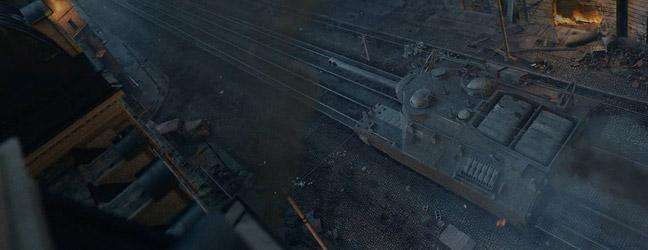
in a re-enactment. The Panzer III is a fairly convincing
replica apparently based on the post-war BMP infantry fighting
vehicle. Like many of the German Army’s earlier vehicles, it’s
painted dark grey. Entering service in 1939, the PzIII was designed
as a well-balanced tank armed with a 37mm gun. It did not take
long, however, before the 37mm was found to be insufficient for the
task, and replaced with a 5cm /42 starting in 1940 with the Ausf H,
and also some late production F and G vehicles. These were the
vehicles which invaded the Soviet Union. Though Hitler had
personally instructed the Panzer IIIs to be upgunned with longer
5cm/60 cannons, all the experts said it could not be done. A Fuhrer
temper tantrum resulted, until someone could be found who said he
could do it. That someone was Direktor Panten, from Alkett.
Production of the long 5cm cannon-armed Pz IIIs commenced late 1941
with the later J-model vehicles, and the Ls, which turned out to be
fortunate as the longer 5cm guns could more easily deal with the
Soviet T-34s that were to be soon encountered. Three vehicles
are easily identifiable on the Soviet side. A destroyed SU-85 is
bypassed by the StuG, this vehicle was tank destroyer mounting the
Tiger-killing 85mm gun on a T-34 chassis. Unfortunately, this
vehicle dates from 1943, but the wreck was on the battlefield the
re-enactors used and wasn’t easy to remove.A counter-attacking BT-7
meets its end next to the wreck of the StuG. This is, of interest,
the last operating one in the world. This light tank, a spiritual
ancestor of T-34, dated back to 1934, itself a later vehicle in a
series begun in 1931. Some 4,500 BT-7s were built by the time
production ended in 1939. As a result, the BTs were not an uncommon
vehicle to be found on the 1941 Soviet battlefield. By 1941,
however, the vehicle was starting to become obsolescent and very
under-armoured, if still dangerous to contemporary pre-war tanks
such as Pz III. Feel free to check out the vehicle itself in this
Youtube link. https://www.youtube.com/watch?v=aA0aV2Lk-ns&list=PLEAEU2gs2Nz8PHEXUHG25ltV4JPDCqxIN The
last vehicle standing is the legendary T-34. Entering service just
in time to defend the USSR, the vehicle was actually not very
numerous in the Soviet tank inventory during those critical first
months. Fairly tough armor, a good gun, and excellent cross-country
mobility belied ergonomic issues inside the tank which hindered
their full effectiveness, but even hindered, the vehicles were
dangerous and capable. Over time, a number of issues were resolved:
The 1943 model partaking in this battle has as a signature feature
a prominent cupola which provided the overworked commander with at
least a reasonable level of visibility around the tank. The
distinctive shape to the turret indicates that this vehicle was
likely produced in Uralmash, near Yekaterinberg. Two anti-tank
guns also make an appearance. 76.2mm ZiS-3, or more formally,
76mm Divisional Gun M1942, was a towed anti-tank field gun
developed by the Soviet Union prior to the outbreak of hostilities
with the Germans. The ZiS-3 was held in very high regard in Soviet
Service as it could reliably knock out the majority of German
armored vehicles with little difficulty. The development of heavier
armored tanks, such as Tiger and Panther necessitated a
replacement, the D-44. However, the ZiS-3 remained in service
throughout the war, as the ZiS-3 could reliably punch through the
sides of newer German tanks. It was also considered useful in an
indirect fire role. After World War II, it was pulled from
service, and surviving examples were passed on to Soviet-allied
nations early in the Cold War. There was an attempt to mount it on
a self-propelled gun carriage, the KSP-7, however, it never entered
production. 45mm Anti-Tank Gun M1937 was another towed field
gun used during the outbreak of hostilities between the Soviet
Union and Germany. The M1937 was designed using components from the
German 37mm Anti-tank gun, and the two have a very similar
appearance. As early as 1941, the gun had difficulty
penetrating the armor of German medium tanks, and assault guns. A
year later, an attempt was made to solve this problem with the
introduction of Armored Piercing Composite Rigid shells with
tungsten carbide cores. These proved very effective, however,
expensive to produce. As a result, a newer, higher velocity 45mm
gun, the M1942, was developed as a replacement.
Comments on the VR 1941 Battle.