








US Centurion, Part 1.
Дата: 14.02.2015 03:45:02
The_Chieftain: You will recall that some time ago I covered the US Army’s
evaluation of the Sherman Firefly in three parts comparing it to
the M4(76) and the M26. Frankly, Firefly didn't fare all that well.
The Cruisers didn't do all that well against Sherman in either
British or American tests either. Well, a couple of years later, a
similar, albeit less rigid, set of tests was conducted, comparing
Centurion to M26 and T29. These tests were a little more
generic, as they were more focused on the tank as a whole rather
than, as in the Firefly’s case, the weapon installation
effectiveness. I’ve come across three Centurion reports so far, and
I’ll go over then over, again, a period of articles. Interestingly,
they are not in the sequence you might expect: The first two
reports were filed on the Centurion III in the first half of 1950,
the third was of the Centurion II in the second half of the year.
This is explained as follows: The two Cent III reports were divided
into gunnery, and automotive. Army Field Forces Board No 2.
[AKA Armored Board – Chieftain] received the Centurion III early in
September 1948. The tank received was the first production model to
be manufactured and, as a conswequence, it was necessary to
proof-fire the main armament at this station. Unfortunately, the
initial amount of 20-poinder ammunition received and the relatively
short tube life prevented a comprehensive testing program. In
addition, shot APCBC is not procurable at present and the gun on
hand mounts a counterbalance in lieu of a muzzle brake as the
design for the brake is not yet firm. Consequently, only
preliminary testing, covered in this report, has been possible to
date; further and complete tests have been postponed pending
receipt of additional HE and APDS ammunition, an allowance of APCBC
ammunition, a muzzle brake, and additional tubes. The interim
period will be spent in a complete evaluation of the stabilizer
installed in a Centurion II tank mounting a 17-pounder gun for
which there is adequate ammunition. This vehicle arrived at Fort
Knox in August of 1948, but certain essential components had
deteriorated so greatly as the result of arduous trials at Aberdeen
Proving Ground as to preclude immediate testing at Fort Knox. It is
expected that this tank will be refitted in November of 1948 and
that the complete evaluation of the stabilisation system
contemplated with the Centurion II will materially reduce the
stabilizer testing required with the Centurion III. 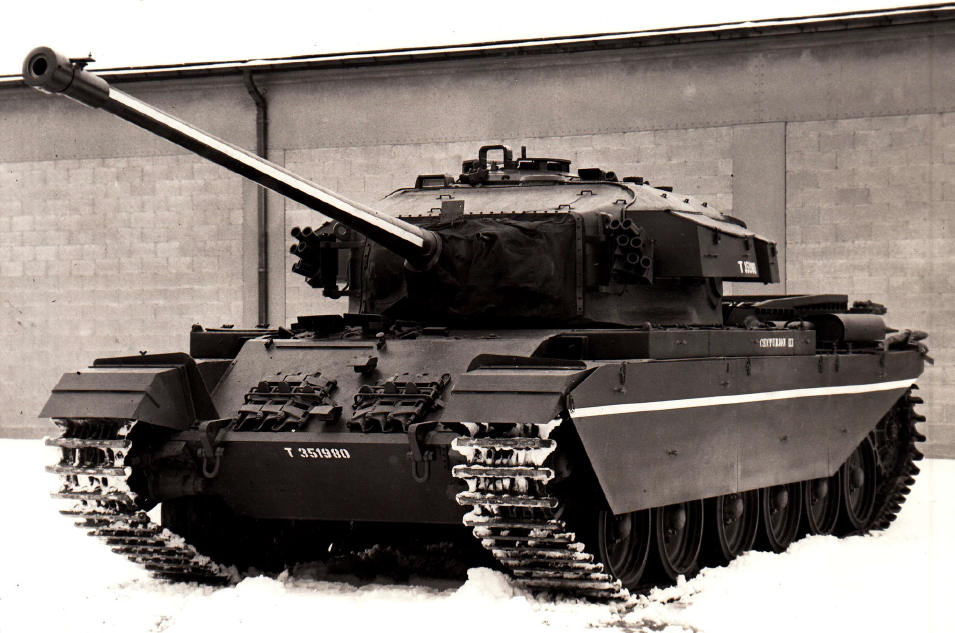 The Centurion III as tested by Armored Board. Note the
painted-on PT belts. I shall now start transcibing the results of
the tests. This is the first test, that of the fighting compartment
of Centurion III. T29 was not incorporated into this first
particular part, sorry. Let's see if Centurion manages to redeem
British tank design in American eyes which, as you will recall from
this and other SUMMARY OF : TESTS. . Testing of the fighting
compartment of the Centurion III has been limited because
of the lack of time and the afore-mentioned shortage of ammunition
and replacement gun tubes. Tests conducted at this station to date
have been of such a nature as to preclude complete evaluation of
any or all features and, of course, proper comparison with similar
items on the Medium Tank, M26, and the Heavy Tank, T29.
Consequently, in no respect can tests of any
single feature or phase be regarded
as complete; and results, although in many instances
strongly indicative, are not necessarily representative of final
judgment on stabilization,fire control, and main
armament. Result of limited testing conducted to
date are: a. Reliability, The Centurion III, which was new
when received, has been operated a total of 305 miles. The power
traverse system, non-stabilized, has been operated intermittently
approximately 9 hours, 40 percent of which was under stand-to or
light load. The stabilizer system (which includes power traverse)
has been operated intermittently an additional 8
½ hours, some 25 percent of which cap
be considered as stand-to or light load. In addition,
6 specia1 proof rounds, 63 rounds of shell HE and 69,
rounds of shot, APDS have been fired, in the main, from a
stationary vehJcle. This expenditure of ammunition
represents approximately 41 equivalent full charge rounds
(EFC) or 69 percent of the estimated life of the presently
installed tube. The expected tube life is 60 EFC, which amounts to
120 rounds of shot APDS or l,200 rounds of Shell, HE,and at this
figure the expected mean wear is 0.12 inches. The present maximum
wear at commencement of rifling, which is
0.087 inches, confirms the predicted short life of the
20-pounder tube. During the life of the gun the average
loss in velocity is 17 feet per second per 0.01 inches
of wear. During this period no malfunctions or.
discrepancies of any significance have been noted despite the fact
that the muzzle of the 20-pounder was struck a severe blow by
an M26 tank retriever. This accident, incidentally,
broke the gun traveling crutch, pushed the open breech block back
into the deflector guard, and forced the gun to recoil one inch
beyond normal limits without serious consequences. b. Ease of·
maintenance No apparent difficulty
has been experienced in handling, disassembling, or
assembling those items normally subject to field maintenance by
tank crewmen. c. Fightability.
1) Observation of Fire. When firing shell HE of comparable muzzle
velocities, no material difference has been noted between the
Centurion III and the M26 in ability of crew members to observe
fire.k However, observation of fire from the Centurion III when
firing shot APDS was inferior to that from the M26 when firing shot
HVAP-T. Examination of subsequent sub-paragraphs will disclose the
reasons for this difference, but it must be remembered that
observations apply to the 20-pounder mounting a counterbalance in
lieu of a muzzle brake. The presence of a muzzle brake will
conceivably alter present findings.
a) Blast. Test personnel were uniform in their
opinion that the blast effect on the commander of a 20-pounder
firing APDS was markedly less than that of an 90mm firing HVAP-T.
The blast effect under the muzzle of the 20-pounder was much more
severe than that under the 90mm muzzle, and as a result, the dust
raised by the former was a great hindrance to observation.
b) Muzzle flash. Muzzle flash
with the 20-pounder was greater and it was felt that it interfered
considerably with the commander’s observation of tracers. Blinking
during the instant of firing did not help materially. This flash
was not visible to the gunner.
c) Tracers. Tracers were always visible to flank observers.
However, crew members of the Centurion III experienced great
difficulty in spotting tracers because of in-experience, muzzle
flash, short time of flight and, above all, dust; whereas HVAP-T
tracers in the target area were normally visible to crewment of the
M26. With dust dampened, the experienced British gunner was able to
pick up about 50 percent of the tracers when firing at ranges in
excess of 1,600 yards. d)
Fumes. Fumes from both shell HE and shot APDS were less noticeable
and far less irritating in the Centurion III than in the M26 firing
either shell or shot. 2)
Adjustment of Fire. No difference in ease of adjustment of fire was
apparent between comparable types of high explosive fired from the
20-pounder and the 90mm. Adjustment of fire with the shot APDS, on
the other hand, was more difficult because of the poor observation
from the Centurion III as outlined above. However, this did not
prevent the Centurion III from acquitting itself favourably in
initial and abbreviated ease of adjustment problems. The 20-pounder
achieved 3 direct hits and one ricochet hit out of 7 rounds when
firing at three 6’ x 6’ olive drab targets at ranges varying from
1,800 yards to 2,800 yards, while the 90mm firing HVAP-T and using
an M83C telescope graduated for ABC obtained 2 hits out of six
rounds at two similar targets 1,800 and 2,500 yards, and failed to
get a hit at 2,800 yards with 5 rounds. Users and observers
attributed this favourable showing to the flat trajectory of the
discarding sabot ammunition which partially negated ranging errors
and deflection errors due to cant. In addition, and because of this
flat trajectory, a standard correction of up or down 200 yards (on
the range drum) was used in adjusting fire with 20-pounder shot
APDS. Again, all were of the opinion that this method of adjustment
was feasible and that its use would eliminate the necessity for
accurate sensings in terms of displacement between projectile and
target since such a correction could be based, normally, upon a
mere sensing of short or over. It is interesting to note that after
an unsensed (except by flank observers) ricochet hit at 2,800 yards
on the first round, the commander of the Centurion violated this
arbitrary method of adjustment and elected to correct in terms of
displacement and range error. This projectile struck at the base of
the target and it required a third round to obtain a hit.
3) Handling and loading
ammunition. No specific trials of this nature have been conducted;
however there is no reason to believe that the rate of fire of the
20-pounder will differ appreciably from that of the 90mm. The
various loaders used have expressed a preference for the Centurion
III, despite the fact that the 20-pounder breech is higher than
that of the 90mm, stressing the more ample space provided by the
loader and the smooth breech action of the 20-pounder. A total of
65 rounds of ammunition are stowed: 8 rounds are quickly available
in ready racks, 20 are in the forward part of the hull to the left
of the driver, 2 are in rear bulkhead, and the remainder are in
turret floor bins. Access to the front hull bin is possible except
when the turret is being traversed counterclockwise approximately
from 0-180 degrees, but access to the floor bins is difficult under
any circumstances because of the spent case bin. :Ejection of empty
brass. No failures to eject the empty cartridge cases have been
encountered. In addition, performance of the spent case bin has
been completely satisfactory, which is essential because the turret
basket is only a 90 degree segment. Gun controls.
a) Manual Traverse. Operation of manual traverse is far from
satisfactory because of the presence of the Autolok which very
effectively prevents undesired turret rotation during vehicular
movement. As a result, unless operated by a skilled gunner capable
of applying a continuous and uniform force, movement is jerky. In
addition, at certain turret positions when the tank is pitched
rotation in one direction or the other can be accomplished only by
repeated blows on the handwheel. The traversing handwheel in some
respects is conveniently located. However, its position does not
facilitate the continuous effort required for traversing, and
clearance between the handwheel and power traverse controller is at
a minimum.
b) Power traverse controller. The vertical spade grip in most
respects appears satisfactory although complete evaluation must
await further testing. The fine response possible with this system
permits accurate and quick laying on stationary point targets and
precise tracking of slow moving targets. However, the necessity of
continually gripping the controller in order to keep the clutch
switch compressed is fatiguing. In addition, the position of the
controller requires the gunner to thrust his arm under the manual
traverse handwheel and around one side or the other of the vertical
handle on that wheel. This handwheel, however, does not rotate when
using power traverse.
c) Commander’s
controller. This controller, located at an angle below and to the
right front of the commander, with the grip up, appears to be
highly suitable and properly positioned. It is felt that less
strain is experienced operating this controller and most users
prefer it to the gunner’s vertical spade grip which seems
heavier.
d) Elevation
handwheel. Operation of this handwheel, located to the left and
forward of the gunner, and of the elevation mechanism as a whole is
extremely satisfactory. The handwheel mounts a comfortable and
substantial horizontal grip with firing button and the position of
the hand when elevating seems natural.
e) Power
elevation controller. Limited observation has disclosed no
deficiencies. This controller is positioned head-high and well
forward on the gunner’s left and the traverse controller waise high
and to his right front. This combination seems to enable the gunner
to position himself firmly with brow against sight pad.
f) Machine
gun mechanical firing gear. This firing control has not been tested
to date, but it is a foot pedal with disadvantages inherent in that
type of equipment.
g) Electrical
firing switches. Main armament switches located on both elevation
controls appear adequate. In fact, gunners expressed a strong
preference for the location of the firing button on the elevation
controls. There is no emergency means of firing the main armament,
although such a gear is planned.
6) Fire control equipment.
a) Gunner’s periscope. The gunner’s periscope, used in conjunction
with the range drum, has many advantages when compared with
presently installed U.S. sights. The combination is extremely
valuable when firing from a moving vehicle as either the commander
the gunner, using the range adjuster on the range drum, can
continually set in range changes. An experienced gunner,
incidentally, can read essential scales with his left eye through a
reflector on the left side of the 6-power eyepiece without removing
his right eye from the periscope sight. He must, however, release
the elevation control and firing button in order to operate the
range adjuster. In addition, the periscope appears to lend itself
readily to the elevation motions which are of a considerable
magnitude and violence in stabilized firing; it has a large and
readily available field of vision. The sight-range drum combination
is equally valuable when engaging a moving target as it enables the
gunner to set in a range and to place a lead line on or in line
with the target, eliminating tracking in an empty space on the
reticle. On the other hand, it is felt that the lack of a
definiteaiming point or cross in this reticle does limit the
gunner’s ability to repeat the same laying in stationary firing.
The aiming area, so to speak, is an imaginary square, 5 minutes on
a side, formed by two pairs of vertical lines. Moreover, as with
most mechanical linkages, backlash exists in the rotating range
drum and in the pivoted periscope. It is felt that the construction
of the range drum could be improved and that, at least, it should
be made dust-proof. There is no built-in correction for drift or
cant, and the principle of design and basic operation preclude such
corrections. b)
Cupola episcopes. No limits of vision tests have been run;
however, the nine episcopes mounted in the commander cupola would
appear to have value during moving vehicle firing.
c) Vane sight. This sight
has not been tested as yet, but appears more practical than the
version on the M26.
d) Clinometer. The clinometer is fastened to the range drum
mounting and is so positioned as to make accurate reading
difficult. The adjusting nut or lock is unsatisfactory.
e) Azimuth indicator. The
indicator is all-electric and seems to be very satisfactory. It is
ideally positioned directly in front of the gunner and is graduated
in degrees and minutes.
f) associated electrical equipment. Illumination devices
appear satisfactory. The two bulbs in the azimuth indicator are
poorly mounted from a viewpoint of sturdiness.
7) Stabiliser. Stabiliser
tests have not been initiated. Results outlined below are based
upon observations during practice and demonstrations.
a) Warm-up time. It
required 36 minutes to place the stabilizer in operation. Thirty
minutes of this time are consumed in warming the gyros by turning
on the master battery switch which in turn actuates the gyro
heaters. In addition, the main motor should be operated 1 minute
before staring the auxiliary motor, and it requires 5 minutes for
the alternator to warm up.
b) Controls. The alternator and metadyne
switches to the left and below the gunner are awkwardly located and
the switches are so arranged as to encourage mistakes. However, the
operation required to stablise is simple and consists of locking
the elevation handwheel, which is easily accomplished, and of
throwing the stabilizer change-over lever to the right. The
procedure to change back to straight power traverse is about the
same, unlocking the handwheel and returning the change-over lever
to its original position, but the necessity of meshing gears,
although a minor problem, consumes slightly more time. The
elevation and traverse trimmers appear to be conveniently located.
8)
Safety devices. The loader’s firing safety switch and loader’s
traverse safety switch, depression stop switch and limit switches,
and recoil indicator are desirable features. Actually two traverse
safety switches appear to be necessary.
9) Turret seats and seating
arrangement. Seats appear sturdy, are readily adjustable, and no
malfunctions have occurred to date. The gunner’s position is
confined by such space as is available is efficiently utilized. The
gunner does have difficulty reaching his seat and, in addition, the
smoke ejector firing buttons are suspended from the turret roof
immediately in rear of his head which is a hazard. The commander’s
position in the Centurion is exceptionally well planned and
arranged in contrast to that of the M26.
10) Hatches. All turret
hatches have functioned normally, although some hatch locks are
poorly positioned. The location of the escape hatch in the rear of
the turret appears extremely practical. I’m going to skip
some of the technical stuff but do make the following notations:
With the tank level, it took about 4 pounds of pressure to manually
traverse the turret, the average gunner could crank at
19.5mils/second. (A little over two cranks a second). The gun was
very well balanced, with average elevation effort being 2 pounds to
elevate, and 4 to depress.
e. Dispersion Firing.
1. Shell, HE.
(a) Ten
consecutive rounds fired at each of the following measured ranges
at a vertical, 12’ x 12’ panel with aiming point.
The Centurion III as tested by Armored Board. Note the
painted-on PT belts. I shall now start transcibing the results of
the tests. This is the first test, that of the fighting compartment
of Centurion III. T29 was not incorporated into this first
particular part, sorry. Let's see if Centurion manages to redeem
British tank design in American eyes which, as you will recall from
this and other SUMMARY OF : TESTS. . Testing of the fighting
compartment of the Centurion III has been limited because
of the lack of time and the afore-mentioned shortage of ammunition
and replacement gun tubes. Tests conducted at this station to date
have been of such a nature as to preclude complete evaluation of
any or all features and, of course, proper comparison with similar
items on the Medium Tank, M26, and the Heavy Tank, T29.
Consequently, in no respect can tests of any
single feature or phase be regarded
as complete; and results, although in many instances
strongly indicative, are not necessarily representative of final
judgment on stabilization,fire control, and main
armament. Result of limited testing conducted to
date are: a. Reliability, The Centurion III, which was new
when received, has been operated a total of 305 miles. The power
traverse system, non-stabilized, has been operated intermittently
approximately 9 hours, 40 percent of which was under stand-to or
light load. The stabilizer system (which includes power traverse)
has been operated intermittently an additional 8
½ hours, some 25 percent of which cap
be considered as stand-to or light load. In addition,
6 specia1 proof rounds, 63 rounds of shell HE and 69,
rounds of shot, APDS have been fired, in the main, from a
stationary vehJcle. This expenditure of ammunition
represents approximately 41 equivalent full charge rounds
(EFC) or 69 percent of the estimated life of the presently
installed tube. The expected tube life is 60 EFC, which amounts to
120 rounds of shot APDS or l,200 rounds of Shell, HE,and at this
figure the expected mean wear is 0.12 inches. The present maximum
wear at commencement of rifling, which is
0.087 inches, confirms the predicted short life of the
20-pounder tube. During the life of the gun the average
loss in velocity is 17 feet per second per 0.01 inches
of wear. During this period no malfunctions or.
discrepancies of any significance have been noted despite the fact
that the muzzle of the 20-pounder was struck a severe blow by
an M26 tank retriever. This accident, incidentally,
broke the gun traveling crutch, pushed the open breech block back
into the deflector guard, and forced the gun to recoil one inch
beyond normal limits without serious consequences. b. Ease of·
maintenance No apparent difficulty
has been experienced in handling, disassembling, or
assembling those items normally subject to field maintenance by
tank crewmen. c. Fightability.
1) Observation of Fire. When firing shell HE of comparable muzzle
velocities, no material difference has been noted between the
Centurion III and the M26 in ability of crew members to observe
fire.k However, observation of fire from the Centurion III when
firing shot APDS was inferior to that from the M26 when firing shot
HVAP-T. Examination of subsequent sub-paragraphs will disclose the
reasons for this difference, but it must be remembered that
observations apply to the 20-pounder mounting a counterbalance in
lieu of a muzzle brake. The presence of a muzzle brake will
conceivably alter present findings.
a) Blast. Test personnel were uniform in their
opinion that the blast effect on the commander of a 20-pounder
firing APDS was markedly less than that of an 90mm firing HVAP-T.
The blast effect under the muzzle of the 20-pounder was much more
severe than that under the 90mm muzzle, and as a result, the dust
raised by the former was a great hindrance to observation.
b) Muzzle flash. Muzzle flash
with the 20-pounder was greater and it was felt that it interfered
considerably with the commander’s observation of tracers. Blinking
during the instant of firing did not help materially. This flash
was not visible to the gunner.
c) Tracers. Tracers were always visible to flank observers.
However, crew members of the Centurion III experienced great
difficulty in spotting tracers because of in-experience, muzzle
flash, short time of flight and, above all, dust; whereas HVAP-T
tracers in the target area were normally visible to crewment of the
M26. With dust dampened, the experienced British gunner was able to
pick up about 50 percent of the tracers when firing at ranges in
excess of 1,600 yards. d)
Fumes. Fumes from both shell HE and shot APDS were less noticeable
and far less irritating in the Centurion III than in the M26 firing
either shell or shot. 2)
Adjustment of Fire. No difference in ease of adjustment of fire was
apparent between comparable types of high explosive fired from the
20-pounder and the 90mm. Adjustment of fire with the shot APDS, on
the other hand, was more difficult because of the poor observation
from the Centurion III as outlined above. However, this did not
prevent the Centurion III from acquitting itself favourably in
initial and abbreviated ease of adjustment problems. The 20-pounder
achieved 3 direct hits and one ricochet hit out of 7 rounds when
firing at three 6’ x 6’ olive drab targets at ranges varying from
1,800 yards to 2,800 yards, while the 90mm firing HVAP-T and using
an M83C telescope graduated for ABC obtained 2 hits out of six
rounds at two similar targets 1,800 and 2,500 yards, and failed to
get a hit at 2,800 yards with 5 rounds. Users and observers
attributed this favourable showing to the flat trajectory of the
discarding sabot ammunition which partially negated ranging errors
and deflection errors due to cant. In addition, and because of this
flat trajectory, a standard correction of up or down 200 yards (on
the range drum) was used in adjusting fire with 20-pounder shot
APDS. Again, all were of the opinion that this method of adjustment
was feasible and that its use would eliminate the necessity for
accurate sensings in terms of displacement between projectile and
target since such a correction could be based, normally, upon a
mere sensing of short or over. It is interesting to note that after
an unsensed (except by flank observers) ricochet hit at 2,800 yards
on the first round, the commander of the Centurion violated this
arbitrary method of adjustment and elected to correct in terms of
displacement and range error. This projectile struck at the base of
the target and it required a third round to obtain a hit.
3) Handling and loading
ammunition. No specific trials of this nature have been conducted;
however there is no reason to believe that the rate of fire of the
20-pounder will differ appreciably from that of the 90mm. The
various loaders used have expressed a preference for the Centurion
III, despite the fact that the 20-pounder breech is higher than
that of the 90mm, stressing the more ample space provided by the
loader and the smooth breech action of the 20-pounder. A total of
65 rounds of ammunition are stowed: 8 rounds are quickly available
in ready racks, 20 are in the forward part of the hull to the left
of the driver, 2 are in rear bulkhead, and the remainder are in
turret floor bins. Access to the front hull bin is possible except
when the turret is being traversed counterclockwise approximately
from 0-180 degrees, but access to the floor bins is difficult under
any circumstances because of the spent case bin. :Ejection of empty
brass. No failures to eject the empty cartridge cases have been
encountered. In addition, performance of the spent case bin has
been completely satisfactory, which is essential because the turret
basket is only a 90 degree segment. Gun controls.
a) Manual Traverse. Operation of manual traverse is far from
satisfactory because of the presence of the Autolok which very
effectively prevents undesired turret rotation during vehicular
movement. As a result, unless operated by a skilled gunner capable
of applying a continuous and uniform force, movement is jerky. In
addition, at certain turret positions when the tank is pitched
rotation in one direction or the other can be accomplished only by
repeated blows on the handwheel. The traversing handwheel in some
respects is conveniently located. However, its position does not
facilitate the continuous effort required for traversing, and
clearance between the handwheel and power traverse controller is at
a minimum.
b) Power traverse controller. The vertical spade grip in most
respects appears satisfactory although complete evaluation must
await further testing. The fine response possible with this system
permits accurate and quick laying on stationary point targets and
precise tracking of slow moving targets. However, the necessity of
continually gripping the controller in order to keep the clutch
switch compressed is fatiguing. In addition, the position of the
controller requires the gunner to thrust his arm under the manual
traverse handwheel and around one side or the other of the vertical
handle on that wheel. This handwheel, however, does not rotate when
using power traverse.
c) Commander’s
controller. This controller, located at an angle below and to the
right front of the commander, with the grip up, appears to be
highly suitable and properly positioned. It is felt that less
strain is experienced operating this controller and most users
prefer it to the gunner’s vertical spade grip which seems
heavier.
d) Elevation
handwheel. Operation of this handwheel, located to the left and
forward of the gunner, and of the elevation mechanism as a whole is
extremely satisfactory. The handwheel mounts a comfortable and
substantial horizontal grip with firing button and the position of
the hand when elevating seems natural.
e) Power
elevation controller. Limited observation has disclosed no
deficiencies. This controller is positioned head-high and well
forward on the gunner’s left and the traverse controller waise high
and to his right front. This combination seems to enable the gunner
to position himself firmly with brow against sight pad.
f) Machine
gun mechanical firing gear. This firing control has not been tested
to date, but it is a foot pedal with disadvantages inherent in that
type of equipment.
g) Electrical
firing switches. Main armament switches located on both elevation
controls appear adequate. In fact, gunners expressed a strong
preference for the location of the firing button on the elevation
controls. There is no emergency means of firing the main armament,
although such a gear is planned.
6) Fire control equipment.
a) Gunner’s periscope. The gunner’s periscope, used in conjunction
with the range drum, has many advantages when compared with
presently installed U.S. sights. The combination is extremely
valuable when firing from a moving vehicle as either the commander
the gunner, using the range adjuster on the range drum, can
continually set in range changes. An experienced gunner,
incidentally, can read essential scales with his left eye through a
reflector on the left side of the 6-power eyepiece without removing
his right eye from the periscope sight. He must, however, release
the elevation control and firing button in order to operate the
range adjuster. In addition, the periscope appears to lend itself
readily to the elevation motions which are of a considerable
magnitude and violence in stabilized firing; it has a large and
readily available field of vision. The sight-range drum combination
is equally valuable when engaging a moving target as it enables the
gunner to set in a range and to place a lead line on or in line
with the target, eliminating tracking in an empty space on the
reticle. On the other hand, it is felt that the lack of a
definiteaiming point or cross in this reticle does limit the
gunner’s ability to repeat the same laying in stationary firing.
The aiming area, so to speak, is an imaginary square, 5 minutes on
a side, formed by two pairs of vertical lines. Moreover, as with
most mechanical linkages, backlash exists in the rotating range
drum and in the pivoted periscope. It is felt that the construction
of the range drum could be improved and that, at least, it should
be made dust-proof. There is no built-in correction for drift or
cant, and the principle of design and basic operation preclude such
corrections. b)
Cupola episcopes. No limits of vision tests have been run;
however, the nine episcopes mounted in the commander cupola would
appear to have value during moving vehicle firing.
c) Vane sight. This sight
has not been tested as yet, but appears more practical than the
version on the M26.
d) Clinometer. The clinometer is fastened to the range drum
mounting and is so positioned as to make accurate reading
difficult. The adjusting nut or lock is unsatisfactory.
e) Azimuth indicator. The
indicator is all-electric and seems to be very satisfactory. It is
ideally positioned directly in front of the gunner and is graduated
in degrees and minutes.
f) associated electrical equipment. Illumination devices
appear satisfactory. The two bulbs in the azimuth indicator are
poorly mounted from a viewpoint of sturdiness.
7) Stabiliser. Stabiliser
tests have not been initiated. Results outlined below are based
upon observations during practice and demonstrations.
a) Warm-up time. It
required 36 minutes to place the stabilizer in operation. Thirty
minutes of this time are consumed in warming the gyros by turning
on the master battery switch which in turn actuates the gyro
heaters. In addition, the main motor should be operated 1 minute
before staring the auxiliary motor, and it requires 5 minutes for
the alternator to warm up.
b) Controls. The alternator and metadyne
switches to the left and below the gunner are awkwardly located and
the switches are so arranged as to encourage mistakes. However, the
operation required to stablise is simple and consists of locking
the elevation handwheel, which is easily accomplished, and of
throwing the stabilizer change-over lever to the right. The
procedure to change back to straight power traverse is about the
same, unlocking the handwheel and returning the change-over lever
to its original position, but the necessity of meshing gears,
although a minor problem, consumes slightly more time. The
elevation and traverse trimmers appear to be conveniently located.
8)
Safety devices. The loader’s firing safety switch and loader’s
traverse safety switch, depression stop switch and limit switches,
and recoil indicator are desirable features. Actually two traverse
safety switches appear to be necessary.
9) Turret seats and seating
arrangement. Seats appear sturdy, are readily adjustable, and no
malfunctions have occurred to date. The gunner’s position is
confined by such space as is available is efficiently utilized. The
gunner does have difficulty reaching his seat and, in addition, the
smoke ejector firing buttons are suspended from the turret roof
immediately in rear of his head which is a hazard. The commander’s
position in the Centurion is exceptionally well planned and
arranged in contrast to that of the M26.
10) Hatches. All turret
hatches have functioned normally, although some hatch locks are
poorly positioned. The location of the escape hatch in the rear of
the turret appears extremely practical. I’m going to skip
some of the technical stuff but do make the following notations:
With the tank level, it took about 4 pounds of pressure to manually
traverse the turret, the average gunner could crank at
19.5mils/second. (A little over two cranks a second). The gun was
very well balanced, with average elevation effort being 2 pounds to
elevate, and 4 to depress.
e. Dispersion Firing.
1. Shell, HE.
(a) Ten
consecutive rounds fired at each of the following measured ranges
at a vertical, 12’ x 12’ panel with aiming point.  b) With the cold gun, it usually required two or three rounds
to place the center of impact centrally on the target. This
difficulty was aggravated by lack of definite knowledge of required
correction for drift at various ranges. However, once on the
target, all subsequent rounds remained on.
2) Shot APDS
a) Ten consecutive rounds fired at each of the following measured
ranges at a vertical, 12’ x 12’ panel with aiming point.
b) With the cold gun, it usually required two or three rounds
to place the center of impact centrally on the target. This
difficulty was aggravated by lack of definite knowledge of required
correction for drift at various ranges. However, once on the
target, all subsequent rounds remained on.
2) Shot APDS
a) Ten consecutive rounds fired at each of the following measured
ranges at a vertical, 12’ x 12’ panel with aiming point.  b) The
same difficulty noted with high explosive was experienced in
locating center of impact of shot APDS centrally on the target.
Once the center of impact was located it was possible to shift it
to an adjacent piece of armor plate, 55” x 67” at 2,000 yards and
in doing so first round hits were obtained on three different
occasions. c) Note
habitual difference between overall size of the 100 percent and the
80 percent group in the table above. This difference points up the
observed fact that one or two rounds out of every ten deviated
considerably from the center of impact.
3) Reasons for dispersion.
a) Inability to repeat exact lay each time with 6-power periscope
as previously discussed.
b) Low muzzle velocity of shell HE which is 2,000 feet per
second. c)
Non-uniform discarding of sabot. – 50 percent of carriers were
normally found within a 10-yard radius of one another, 30-40
percent within a 50-yard radiud, and 10-20 percent were
considerably off in range from the others.
f. Moving target fire.
1) Firing results. Gravity type
target, 6’ x 6’, moving on a diagonal crossing course varying from
1,550 yards to 1,400 yards measured range at an average speed of
13.5 miles per hour, and engaged by stationary vehicle using power
traverse.
b) The
same difficulty noted with high explosive was experienced in
locating center of impact of shot APDS centrally on the target.
Once the center of impact was located it was possible to shift it
to an adjacent piece of armor plate, 55” x 67” at 2,000 yards and
in doing so first round hits were obtained on three different
occasions. c) Note
habitual difference between overall size of the 100 percent and the
80 percent group in the table above. This difference points up the
observed fact that one or two rounds out of every ten deviated
considerably from the center of impact.
3) Reasons for dispersion.
a) Inability to repeat exact lay each time with 6-power periscope
as previously discussed.
b) Low muzzle velocity of shell HE which is 2,000 feet per
second. c)
Non-uniform discarding of sabot. – 50 percent of carriers were
normally found within a 10-yard radius of one another, 30-40
percent within a 50-yard radiud, and 10-20 percent were
considerably off in range from the others.
f. Moving target fire.
1) Firing results. Gravity type
target, 6’ x 6’, moving on a diagonal crossing course varying from
1,550 yards to 1,400 yards measured range at an average speed of
13.5 miles per hour, and engaged by stationary vehicle using power
traverse.  2)
Results can be attributed to the fine degree of control permitted
by power traverse; excellence of manual elevating mechanism,
handwheel and firing button; ability to set range on range drum;
and less likelihood of misses due to elevation errors. Results were
obtained witrhout benefit of round by round sensings by the crew of
the Centurion III. However, a critique was conducted after each
target run. 3) It
is interesting to note that an expert gunner firing 90mm HVAP-T
from an M26 using power traverse failed to get a hit in 18 rounds,
primarily because of elevation errors. When this gunner was shifted
to the Centurion III and given the proper sight picture, he
achieved 3 hits of 3 rounds.
4) The lead required by the M26 firing 90mm
HVAP-T was 7.5 mils from the forward edge of the target, while the
Centurion III firing 20-pounder APDS only required slightly over
half that amount of lead.
g. Stabilized firing. No stabilized firing tests have
been conducted. However, after one dry run and during a
demonstration, an experienced gunner with an inexperienced crew
obtained 2 hits and 3 close shorts with shell HE out of 5 rounds
fired. The range varied from 1,300 to 700 yards, tank speed was 15
miles per hour, and dust raised by strikes in the impact area
handicapped laying.
h. Armor penetration with APDS. The first round fired
(tube life previously expended: 20EFC or 33 percent) at homogenous
plate, 6” x 66” x 67”, at a range of 2,000 yards, inclined at 694
mils (Approximately 39.0 degrees) from vertical and located
slightly above gun (angle of site 6.5mil). A complete penetration
resulted and the top of an M26 turret backing was dented about ¼
inch and a 2-inch piece chipped from cupola cowling. The second
round fired (tube live previously expendsed: 26EFC or 43 percent)
at the same plate inclined 803.8 mils (about 45.2 degrees) and at
the same angle of site struck within 3 inches of the side edge of
the plate, gouding out all but 1 ¼ inches of plate before slewing
out the side. The third round fired (tube life previously expended:
40 EFC,or 67 percent) against the same plate, again at 2,000 yards
and at about 804 mils inclination, failed to penetrate, bulging the
rear surface of the plate slightly. The course of this projectile,
which remained in the hole, was at a considerable upward angle.
Complete data on these three rounds has not been compiled, nor is
the hardness of the plate known. Results appear to substantiate
penetration figures cited by the British. (Note: Earlier in the
report, figures are given as follows: “Tested (British) penetration
of Shot APDS against homogenous plate at 30 degrees is
approximately 8.9 inches at 1,000 yuards, 7.9 inches at 1,500, and
7.1 inches at 2,000 yards)
i. Center of impact firing. Firing results: 10 rounds
shell HE fired at a range of 7,000 yards set up on the range drum,
relaying after each round on two aiming stakes in line.
2)
Results can be attributed to the fine degree of control permitted
by power traverse; excellence of manual elevating mechanism,
handwheel and firing button; ability to set range on range drum;
and less likelihood of misses due to elevation errors. Results were
obtained witrhout benefit of round by round sensings by the crew of
the Centurion III. However, a critique was conducted after each
target run. 3) It
is interesting to note that an expert gunner firing 90mm HVAP-T
from an M26 using power traverse failed to get a hit in 18 rounds,
primarily because of elevation errors. When this gunner was shifted
to the Centurion III and given the proper sight picture, he
achieved 3 hits of 3 rounds.
4) The lead required by the M26 firing 90mm
HVAP-T was 7.5 mils from the forward edge of the target, while the
Centurion III firing 20-pounder APDS only required slightly over
half that amount of lead.
g. Stabilized firing. No stabilized firing tests have
been conducted. However, after one dry run and during a
demonstration, an experienced gunner with an inexperienced crew
obtained 2 hits and 3 close shorts with shell HE out of 5 rounds
fired. The range varied from 1,300 to 700 yards, tank speed was 15
miles per hour, and dust raised by strikes in the impact area
handicapped laying.
h. Armor penetration with APDS. The first round fired
(tube life previously expended: 20EFC or 33 percent) at homogenous
plate, 6” x 66” x 67”, at a range of 2,000 yards, inclined at 694
mils (Approximately 39.0 degrees) from vertical and located
slightly above gun (angle of site 6.5mil). A complete penetration
resulted and the top of an M26 turret backing was dented about ¼
inch and a 2-inch piece chipped from cupola cowling. The second
round fired (tube live previously expendsed: 26EFC or 43 percent)
at the same plate inclined 803.8 mils (about 45.2 degrees) and at
the same angle of site struck within 3 inches of the side edge of
the plate, gouding out all but 1 ¼ inches of plate before slewing
out the side. The third round fired (tube life previously expended:
40 EFC,or 67 percent) against the same plate, again at 2,000 yards
and at about 804 mils inclination, failed to penetrate, bulging the
rear surface of the plate slightly. The course of this projectile,
which remained in the hole, was at a considerable upward angle.
Complete data on these three rounds has not been compiled, nor is
the hardness of the plate known. Results appear to substantiate
penetration figures cited by the British. (Note: Earlier in the
report, figures are given as follows: “Tested (British) penetration
of Shot APDS against homogenous plate at 30 degrees is
approximately 8.9 inches at 1,000 yuards, 7.9 inches at 1,500, and
7.1 inches at 2,000 yards)
i. Center of impact firing. Firing results: 10 rounds
shell HE fired at a range of 7,000 yards set up on the range drum,
relaying after each round on two aiming stakes in line.  j.
Discarding of sabot. Center of impact of carriers after coming to
rest on the ground is between 700 and 800 yards from the tank, and
slightly to the right of the gun-target line.
6.. Conclusions.
As a result of limited testing Army Field Forces Board No. 2
concludes that:
a. In respect to the performance of the 20-pounder gun Mark I:
1) Penetration, firing armor-piercing discarding sabot, is
substantially as rated and the gun is superior in this respect to
the 90-mm tank gun, M3, firing shot, HVAP-T.
2) Dispersion, firing armor piercing discarding sabot and high
explosive is, by accepted standards, slightly greater than that of
the 90mm Tank Gun M3, but that this dispersion is not so great as
to impair the effectiveness of the 20-pounder against armoured and
unarmoured targets.
3) The relatively short tube life (estimated at 120 rounds) firing
armor-piercing shot is not an excessive price to pay for the
improved striking power.
b. The gun controls provided in the Centurion III are
generally superior to those in the Medium Tank M26, exceptions
being the manual traversing mechanism and the present lack of an
emergency firing gear for the main armament.
c. The fire control equipment in the
Centurion III represents a practical solution to a pressing need
and is superior to that in the Medium Tank M26.
d. The comparatively short time of
flight and the flat trajectory achieved with armor-piercing
discarding sabot offer substantial advantages respecting deflection
errors due to cant, lead required against moving targets and
allowing ranging errors against armored targets whether moving or
stationary. e. The
overall characteristics and features of the fighting compartment of
the Centurion III, including the 74-inch turret ring, balanced gun,
and stabilization in azimuth and elevation, result in a far more
fightable turret than that of the Medium Tank M26
f. The fire power and general
fighting efficiency of the Centurion III appear to be superior to
that of the Medium Tank, M46, judging from projected improvements
to be incorporated in the tlatter tank. 7 Recommendations.
Army Field Forces Board No. 2 recommends that:
a) Based on tests conducted to date the 20-pounder Gun, Mark I, and
the turret assembly of the Centurion III be considered superior to
like components of Medium Tank M26
b) Further consideration by development
agencies be given the stabilizer, fire control equipment, and main
armament of the Centution III
j.
Discarding of sabot. Center of impact of carriers after coming to
rest on the ground is between 700 and 800 yards from the tank, and
slightly to the right of the gun-target line.
6.. Conclusions.
As a result of limited testing Army Field Forces Board No. 2
concludes that:
a. In respect to the performance of the 20-pounder gun Mark I:
1) Penetration, firing armor-piercing discarding sabot, is
substantially as rated and the gun is superior in this respect to
the 90-mm tank gun, M3, firing shot, HVAP-T.
2) Dispersion, firing armor piercing discarding sabot and high
explosive is, by accepted standards, slightly greater than that of
the 90mm Tank Gun M3, but that this dispersion is not so great as
to impair the effectiveness of the 20-pounder against armoured and
unarmoured targets.
3) The relatively short tube life (estimated at 120 rounds) firing
armor-piercing shot is not an excessive price to pay for the
improved striking power.
b. The gun controls provided in the Centurion III are
generally superior to those in the Medium Tank M26, exceptions
being the manual traversing mechanism and the present lack of an
emergency firing gear for the main armament.
c. The fire control equipment in the
Centurion III represents a practical solution to a pressing need
and is superior to that in the Medium Tank M26.
d. The comparatively short time of
flight and the flat trajectory achieved with armor-piercing
discarding sabot offer substantial advantages respecting deflection
errors due to cant, lead required against moving targets and
allowing ranging errors against armored targets whether moving or
stationary. e. The
overall characteristics and features of the fighting compartment of
the Centurion III, including the 74-inch turret ring, balanced gun,
and stabilization in azimuth and elevation, result in a far more
fightable turret than that of the Medium Tank M26
f. The fire power and general
fighting efficiency of the Centurion III appear to be superior to
that of the Medium Tank, M46, judging from projected improvements
to be incorporated in the tlatter tank. 7 Recommendations.
Army Field Forces Board No. 2 recommends that:
a) Based on tests conducted to date the 20-pounder Gun, Mark I, and
the turret assembly of the Centurion III be considered superior to
like components of Medium Tank M26
b) Further consideration by development
agencies be given the stabilizer, fire control equipment, and main
armament of the Centution III  H. H. D. Heiberg
Colonel, Cavalry. We'll continue on with the automotive tests next
week. As ever, my Facebook page remains here,
my Youtube channel here,
and Twitch stream (Every Tuesday, and occasional evenings)
is here.
H. H. D. Heiberg
Colonel, Cavalry. We'll continue on with the automotive tests next
week. As ever, my Facebook page remains here,
my Youtube channel here,
and Twitch stream (Every Tuesday, and occasional evenings)
is here.
The Centurion III as tested by Armored Board. Note the
painted-on PT belts. I shall now start transcibing the results of
the tests. This is the first test, that of the fighting compartment
of Centurion III. T29 was not incorporated into this first
particular part, sorry. Let's see if Centurion manages to redeem
British tank design in American eyes which, as you will recall from
this and other SUMMARY OF : TESTS. . Testing of the fighting
compartment of the Centurion III has been limited because
of the lack of time and the afore-mentioned shortage of ammunition
and replacement gun tubes. Tests conducted at this station to date
have been of such a nature as to preclude complete evaluation of
any or all features and, of course, proper comparison with similar
items on the Medium Tank, M26, and the Heavy Tank, T29.
Consequently, in no respect can tests of any
single feature or phase be regarded
as complete; and results, although in many instances
strongly indicative, are not necessarily representative of final
judgment on stabilization,fire control, and main
armament. Result of limited testing conducted to
date are: a. Reliability, The Centurion III, which was new
when received, has been operated a total of 305 miles. The power
traverse system, non-stabilized, has been operated intermittently
approximately 9 hours, 40 percent of which was under stand-to or
light load. The stabilizer system (which includes power traverse)
has been operated intermittently an additional 8
½ hours, some 25 percent of which cap
be considered as stand-to or light load. In addition,
6 specia1 proof rounds, 63 rounds of shell HE and 69,
rounds of shot, APDS have been fired, in the main, from a
stationary vehJcle. This expenditure of ammunition
represents approximately 41 equivalent full charge rounds
(EFC) or 69 percent of the estimated life of the presently
installed tube. The expected tube life is 60 EFC, which amounts to
120 rounds of shot APDS or l,200 rounds of Shell, HE,and at this
figure the expected mean wear is 0.12 inches. The present maximum
wear at commencement of rifling, which is
0.087 inches, confirms the predicted short life of the
20-pounder tube. During the life of the gun the average
loss in velocity is 17 feet per second per 0.01 inches
of wear. During this period no malfunctions or.
discrepancies of any significance have been noted despite the fact
that the muzzle of the 20-pounder was struck a severe blow by
an M26 tank retriever. This accident, incidentally,
broke the gun traveling crutch, pushed the open breech block back
into the deflector guard, and forced the gun to recoil one inch
beyond normal limits without serious consequences. b. Ease of·
maintenance No apparent difficulty
has been experienced in handling, disassembling, or
assembling those items normally subject to field maintenance by
tank crewmen. c. Fightability.
1) Observation of Fire. When firing shell HE of comparable muzzle
velocities, no material difference has been noted between the
Centurion III and the M26 in ability of crew members to observe
fire.k However, observation of fire from the Centurion III when
firing shot APDS was inferior to that from the M26 when firing shot
HVAP-T. Examination of subsequent sub-paragraphs will disclose the
reasons for this difference, but it must be remembered that
observations apply to the 20-pounder mounting a counterbalance in
lieu of a muzzle brake. The presence of a muzzle brake will
conceivably alter present findings.
a) Blast. Test personnel were uniform in their
opinion that the blast effect on the commander of a 20-pounder
firing APDS was markedly less than that of an 90mm firing HVAP-T.
The blast effect under the muzzle of the 20-pounder was much more
severe than that under the 90mm muzzle, and as a result, the dust
raised by the former was a great hindrance to observation.
b) Muzzle flash. Muzzle flash
with the 20-pounder was greater and it was felt that it interfered
considerably with the commander’s observation of tracers. Blinking
during the instant of firing did not help materially. This flash
was not visible to the gunner.
c) Tracers. Tracers were always visible to flank observers.
However, crew members of the Centurion III experienced great
difficulty in spotting tracers because of in-experience, muzzle
flash, short time of flight and, above all, dust; whereas HVAP-T
tracers in the target area were normally visible to crewment of the
M26. With dust dampened, the experienced British gunner was able to
pick up about 50 percent of the tracers when firing at ranges in
excess of 1,600 yards. d)
Fumes. Fumes from both shell HE and shot APDS were less noticeable
and far less irritating in the Centurion III than in the M26 firing
either shell or shot. 2)
Adjustment of Fire. No difference in ease of adjustment of fire was
apparent between comparable types of high explosive fired from the
20-pounder and the 90mm. Adjustment of fire with the shot APDS, on
the other hand, was more difficult because of the poor observation
from the Centurion III as outlined above. However, this did not
prevent the Centurion III from acquitting itself favourably in
initial and abbreviated ease of adjustment problems. The 20-pounder
achieved 3 direct hits and one ricochet hit out of 7 rounds when
firing at three 6’ x 6’ olive drab targets at ranges varying from
1,800 yards to 2,800 yards, while the 90mm firing HVAP-T and using
an M83C telescope graduated for ABC obtained 2 hits out of six
rounds at two similar targets 1,800 and 2,500 yards, and failed to
get a hit at 2,800 yards with 5 rounds. Users and observers
attributed this favourable showing to the flat trajectory of the
discarding sabot ammunition which partially negated ranging errors
and deflection errors due to cant. In addition, and because of this
flat trajectory, a standard correction of up or down 200 yards (on
the range drum) was used in adjusting fire with 20-pounder shot
APDS. Again, all were of the opinion that this method of adjustment
was feasible and that its use would eliminate the necessity for
accurate sensings in terms of displacement between projectile and
target since such a correction could be based, normally, upon a
mere sensing of short or over. It is interesting to note that after
an unsensed (except by flank observers) ricochet hit at 2,800 yards
on the first round, the commander of the Centurion violated this
arbitrary method of adjustment and elected to correct in terms of
displacement and range error. This projectile struck at the base of
the target and it required a third round to obtain a hit.
3) Handling and loading
ammunition. No specific trials of this nature have been conducted;
however there is no reason to believe that the rate of fire of the
20-pounder will differ appreciably from that of the 90mm. The
various loaders used have expressed a preference for the Centurion
III, despite the fact that the 20-pounder breech is higher than
that of the 90mm, stressing the more ample space provided by the
loader and the smooth breech action of the 20-pounder. A total of
65 rounds of ammunition are stowed: 8 rounds are quickly available
in ready racks, 20 are in the forward part of the hull to the left
of the driver, 2 are in rear bulkhead, and the remainder are in
turret floor bins. Access to the front hull bin is possible except
when the turret is being traversed counterclockwise approximately
from 0-180 degrees, but access to the floor bins is difficult under
any circumstances because of the spent case bin. :Ejection of empty
brass. No failures to eject the empty cartridge cases have been
encountered. In addition, performance of the spent case bin has
been completely satisfactory, which is essential because the turret
basket is only a 90 degree segment. Gun controls.
a) Manual Traverse. Operation of manual traverse is far from
satisfactory because of the presence of the Autolok which very
effectively prevents undesired turret rotation during vehicular
movement. As a result, unless operated by a skilled gunner capable
of applying a continuous and uniform force, movement is jerky. In
addition, at certain turret positions when the tank is pitched
rotation in one direction or the other can be accomplished only by
repeated blows on the handwheel. The traversing handwheel in some
respects is conveniently located. However, its position does not
facilitate the continuous effort required for traversing, and
clearance between the handwheel and power traverse controller is at
a minimum.
b) Power traverse controller. The vertical spade grip in most
respects appears satisfactory although complete evaluation must
await further testing. The fine response possible with this system
permits accurate and quick laying on stationary point targets and
precise tracking of slow moving targets. However, the necessity of
continually gripping the controller in order to keep the clutch
switch compressed is fatiguing. In addition, the position of the
controller requires the gunner to thrust his arm under the manual
traverse handwheel and around one side or the other of the vertical
handle on that wheel. This handwheel, however, does not rotate when
using power traverse.
c) Commander’s
controller. This controller, located at an angle below and to the
right front of the commander, with the grip up, appears to be
highly suitable and properly positioned. It is felt that less
strain is experienced operating this controller and most users
prefer it to the gunner’s vertical spade grip which seems
heavier.
d) Elevation
handwheel. Operation of this handwheel, located to the left and
forward of the gunner, and of the elevation mechanism as a whole is
extremely satisfactory. The handwheel mounts a comfortable and
substantial horizontal grip with firing button and the position of
the hand when elevating seems natural.
e) Power
elevation controller. Limited observation has disclosed no
deficiencies. This controller is positioned head-high and well
forward on the gunner’s left and the traverse controller waise high
and to his right front. This combination seems to enable the gunner
to position himself firmly with brow against sight pad.
f) Machine
gun mechanical firing gear. This firing control has not been tested
to date, but it is a foot pedal with disadvantages inherent in that
type of equipment.
g) Electrical
firing switches. Main armament switches located on both elevation
controls appear adequate. In fact, gunners expressed a strong
preference for the location of the firing button on the elevation
controls. There is no emergency means of firing the main armament,
although such a gear is planned.
6) Fire control equipment.
a) Gunner’s periscope. The gunner’s periscope, used in conjunction
with the range drum, has many advantages when compared with
presently installed U.S. sights. The combination is extremely
valuable when firing from a moving vehicle as either the commander
the gunner, using the range adjuster on the range drum, can
continually set in range changes. An experienced gunner,
incidentally, can read essential scales with his left eye through a
reflector on the left side of the 6-power eyepiece without removing
his right eye from the periscope sight. He must, however, release
the elevation control and firing button in order to operate the
range adjuster. In addition, the periscope appears to lend itself
readily to the elevation motions which are of a considerable
magnitude and violence in stabilized firing; it has a large and
readily available field of vision. The sight-range drum combination
is equally valuable when engaging a moving target as it enables the
gunner to set in a range and to place a lead line on or in line
with the target, eliminating tracking in an empty space on the
reticle. On the other hand, it is felt that the lack of a
definiteaiming point or cross in this reticle does limit the
gunner’s ability to repeat the same laying in stationary firing.
The aiming area, so to speak, is an imaginary square, 5 minutes on
a side, formed by two pairs of vertical lines. Moreover, as with
most mechanical linkages, backlash exists in the rotating range
drum and in the pivoted periscope. It is felt that the construction
of the range drum could be improved and that, at least, it should
be made dust-proof. There is no built-in correction for drift or
cant, and the principle of design and basic operation preclude such
corrections. b)
Cupola episcopes. No limits of vision tests have been run;
however, the nine episcopes mounted in the commander cupola would
appear to have value during moving vehicle firing.
c) Vane sight. This sight
has not been tested as yet, but appears more practical than the
version on the M26.
d) Clinometer. The clinometer is fastened to the range drum
mounting and is so positioned as to make accurate reading
difficult. The adjusting nut or lock is unsatisfactory.
e) Azimuth indicator. The
indicator is all-electric and seems to be very satisfactory. It is
ideally positioned directly in front of the gunner and is graduated
in degrees and minutes.
f) associated electrical equipment. Illumination devices
appear satisfactory. The two bulbs in the azimuth indicator are
poorly mounted from a viewpoint of sturdiness.
7) Stabiliser. Stabiliser
tests have not been initiated. Results outlined below are based
upon observations during practice and demonstrations.
a) Warm-up time. It
required 36 minutes to place the stabilizer in operation. Thirty
minutes of this time are consumed in warming the gyros by turning
on the master battery switch which in turn actuates the gyro
heaters. In addition, the main motor should be operated 1 minute
before staring the auxiliary motor, and it requires 5 minutes for
the alternator to warm up.
b) Controls. The alternator and metadyne
switches to the left and below the gunner are awkwardly located and
the switches are so arranged as to encourage mistakes. However, the
operation required to stablise is simple and consists of locking
the elevation handwheel, which is easily accomplished, and of
throwing the stabilizer change-over lever to the right. The
procedure to change back to straight power traverse is about the
same, unlocking the handwheel and returning the change-over lever
to its original position, but the necessity of meshing gears,
although a minor problem, consumes slightly more time. The
elevation and traverse trimmers appear to be conveniently located.
8)
Safety devices. The loader’s firing safety switch and loader’s
traverse safety switch, depression stop switch and limit switches,
and recoil indicator are desirable features. Actually two traverse
safety switches appear to be necessary.
9) Turret seats and seating
arrangement. Seats appear sturdy, are readily adjustable, and no
malfunctions have occurred to date. The gunner’s position is
confined by such space as is available is efficiently utilized. The
gunner does have difficulty reaching his seat and, in addition, the
smoke ejector firing buttons are suspended from the turret roof
immediately in rear of his head which is a hazard. The commander’s
position in the Centurion is exceptionally well planned and
arranged in contrast to that of the M26.
10) Hatches. All turret
hatches have functioned normally, although some hatch locks are
poorly positioned. The location of the escape hatch in the rear of
the turret appears extremely practical. I’m going to skip
some of the technical stuff but do make the following notations:
With the tank level, it took about 4 pounds of pressure to manually
traverse the turret, the average gunner could crank at
19.5mils/second. (A little over two cranks a second). The gun was
very well balanced, with average elevation effort being 2 pounds to
elevate, and 4 to depress.
e. Dispersion Firing.
1. Shell, HE.
(a) Ten
consecutive rounds fired at each of the following measured ranges
at a vertical, 12’ x 12’ panel with aiming point.
b) With the cold gun, it usually required two or three rounds
to place the center of impact centrally on the target. This
difficulty was aggravated by lack of definite knowledge of required
correction for drift at various ranges. However, once on the
target, all subsequent rounds remained on.
2) Shot APDS
a) Ten consecutive rounds fired at each of the following measured
ranges at a vertical, 12’ x 12’ panel with aiming point. b) The
same difficulty noted with high explosive was experienced in
locating center of impact of shot APDS centrally on the target.
Once the center of impact was located it was possible to shift it
to an adjacent piece of armor plate, 55” x 67” at 2,000 yards and
in doing so first round hits were obtained on three different
occasions. c) Note
habitual difference between overall size of the 100 percent and the
80 percent group in the table above. This difference points up the
observed fact that one or two rounds out of every ten deviated
considerably from the center of impact.
3) Reasons for dispersion.
a) Inability to repeat exact lay each time with 6-power periscope
as previously discussed.
b) Low muzzle velocity of shell HE which is 2,000 feet per
second. c)
Non-uniform discarding of sabot. – 50 percent of carriers were
normally found within a 10-yard radius of one another, 30-40
percent within a 50-yard radiud, and 10-20 percent were
considerably off in range from the others.
f. Moving target fire.
1) Firing results. Gravity type
target, 6’ x 6’, moving on a diagonal crossing course varying from
1,550 yards to 1,400 yards measured range at an average speed of
13.5 miles per hour, and engaged by stationary vehicle using power
traverse. 2)
Results can be attributed to the fine degree of control permitted
by power traverse; excellence of manual elevating mechanism,
handwheel and firing button; ability to set range on range drum;
and less likelihood of misses due to elevation errors. Results were
obtained witrhout benefit of round by round sensings by the crew of
the Centurion III. However, a critique was conducted after each
target run. 3) It
is interesting to note that an expert gunner firing 90mm HVAP-T
from an M26 using power traverse failed to get a hit in 18 rounds,
primarily because of elevation errors. When this gunner was shifted
to the Centurion III and given the proper sight picture, he
achieved 3 hits of 3 rounds.
4) The lead required by the M26 firing 90mm
HVAP-T was 7.5 mils from the forward edge of the target, while the
Centurion III firing 20-pounder APDS only required slightly over
half that amount of lead.
g. Stabilized firing. No stabilized firing tests have
been conducted. However, after one dry run and during a
demonstration, an experienced gunner with an inexperienced crew
obtained 2 hits and 3 close shorts with shell HE out of 5 rounds
fired. The range varied from 1,300 to 700 yards, tank speed was 15
miles per hour, and dust raised by strikes in the impact area
handicapped laying.
h. Armor penetration with APDS. The first round fired
(tube life previously expended: 20EFC or 33 percent) at homogenous
plate, 6” x 66” x 67”, at a range of 2,000 yards, inclined at 694
mils (Approximately 39.0 degrees) from vertical and located
slightly above gun (angle of site 6.5mil). A complete penetration
resulted and the top of an M26 turret backing was dented about ¼
inch and a 2-inch piece chipped from cupola cowling. The second
round fired (tube live previously expendsed: 26EFC or 43 percent)
at the same plate inclined 803.8 mils (about 45.2 degrees) and at
the same angle of site struck within 3 inches of the side edge of
the plate, gouding out all but 1 ¼ inches of plate before slewing
out the side. The third round fired (tube life previously expended:
40 EFC,or 67 percent) against the same plate, again at 2,000 yards
and at about 804 mils inclination, failed to penetrate, bulging the
rear surface of the plate slightly. The course of this projectile,
which remained in the hole, was at a considerable upward angle.
Complete data on these three rounds has not been compiled, nor is
the hardness of the plate known. Results appear to substantiate
penetration figures cited by the British. (Note: Earlier in the
report, figures are given as follows: “Tested (British) penetration
of Shot APDS against homogenous plate at 30 degrees is
approximately 8.9 inches at 1,000 yuards, 7.9 inches at 1,500, and
7.1 inches at 2,000 yards)
i. Center of impact firing. Firing results: 10 rounds
shell HE fired at a range of 7,000 yards set up on the range drum,
relaying after each round on two aiming stakes in line. j.
Discarding of sabot. Center of impact of carriers after coming to
rest on the ground is between 700 and 800 yards from the tank, and
slightly to the right of the gun-target line.
6.. Conclusions.
As a result of limited testing Army Field Forces Board No. 2
concludes that:
a. In respect to the performance of the 20-pounder gun Mark I:
1) Penetration, firing armor-piercing discarding sabot, is
substantially as rated and the gun is superior in this respect to
the 90-mm tank gun, M3, firing shot, HVAP-T.
2) Dispersion, firing armor piercing discarding sabot and high
explosive is, by accepted standards, slightly greater than that of
the 90mm Tank Gun M3, but that this dispersion is not so great as
to impair the effectiveness of the 20-pounder against armoured and
unarmoured targets.
3) The relatively short tube life (estimated at 120 rounds) firing
armor-piercing shot is not an excessive price to pay for the
improved striking power.
b. The gun controls provided in the Centurion III are
generally superior to those in the Medium Tank M26, exceptions
being the manual traversing mechanism and the present lack of an
emergency firing gear for the main armament.
c. The fire control equipment in the
Centurion III represents a practical solution to a pressing need
and is superior to that in the Medium Tank M26.
d. The comparatively short time of
flight and the flat trajectory achieved with armor-piercing
discarding sabot offer substantial advantages respecting deflection
errors due to cant, lead required against moving targets and
allowing ranging errors against armored targets whether moving or
stationary. e. The
overall characteristics and features of the fighting compartment of
the Centurion III, including the 74-inch turret ring, balanced gun,
and stabilization in azimuth and elevation, result in a far more
fightable turret than that of the Medium Tank M26
f. The fire power and general
fighting efficiency of the Centurion III appear to be superior to
that of the Medium Tank, M46, judging from projected improvements
to be incorporated in the tlatter tank. 7 Recommendations.
Army Field Forces Board No. 2 recommends that:
a) Based on tests conducted to date the 20-pounder Gun, Mark I, and
the turret assembly of the Centurion III be considered superior to
like components of Medium Tank M26
b) Further consideration by development
agencies be given the stabilizer, fire control equipment, and main
armament of the Centution III
H. H. D. Heiberg
Colonel, Cavalry. We'll continue on with the automotive tests next
week. As ever, my Facebook page remains here,
my Youtube channel here,
and Twitch stream (Every Tuesday, and occasional evenings)
is here.US Centurion, Part 1.