








Fury: Battling German Die-Hards
Дата: 25.10.2014 23:01:26
The_Chieftain: Today's Cheiftain's Hatch article was written by Harry Yeide. US Army tankers, by late March
1945, when the final surge into Germany began, were among the most
savvy graduates of the school of war. They knew how to storm cities
and deal with small groups of defenders in villages or at
crossroads. They could slog through fortifications and run like the
cavalry of old. By and large, they had worked out effective
teamwork strategies with the infantry, tank destroyers, and
artillery, even if still a bit ambivalent about their friends in
the fighter-bombers above them. They had learned to beat better
tanks and worked out a series of pragmatic technical solutions to
problems ranging from communication to moving on ice. The German
Army fought on like a body without a brain—OKW records show it was
often a couple days behind developments on the battlefield, and
headquarters at all levels had difficulty delivering orders to
units that often existed only on paper. Lt. Gen. George Patton’s
G-2 shop estimated that as of March 17, total German tank strength
on the western front amounted to the equivalent of a single
full-strength panzer division.1 As of March 31, the entire force of
panzers and assault guns in Third Army’s sector was estimated at
only 55 vehicles, all opposite XX Corps in the Fulda area.2
Cornelius Ryan captured the essence of the final push: “The race
was on. Never in the history of warfare had so many men moved so
fast. The speed of the Anglo-American offensive was contagious, and
all along the front, the drive was taking on the proportions of a
giant contest.”3 So fast, indeed; between April 24 and
30, the 737th Tank Battalion moved 520 miles.4 The Ninth Army
pounded in the direction of Berlin all the way to the Elbe River.
Just to the south, First Army advanced to the Mulde River. Patton’s
Third Army drove toward Czechoslovakia, and Seventh Army pushed
through Bavaria toward the rumored Nazi National Redoubt in the
Bavarian Alps and Austria.5 The tankers rolled past columns of
German POWs heading for the rear, often with no supervision.
Increasingly, displaced persons and released Allied POWs also
appeared. 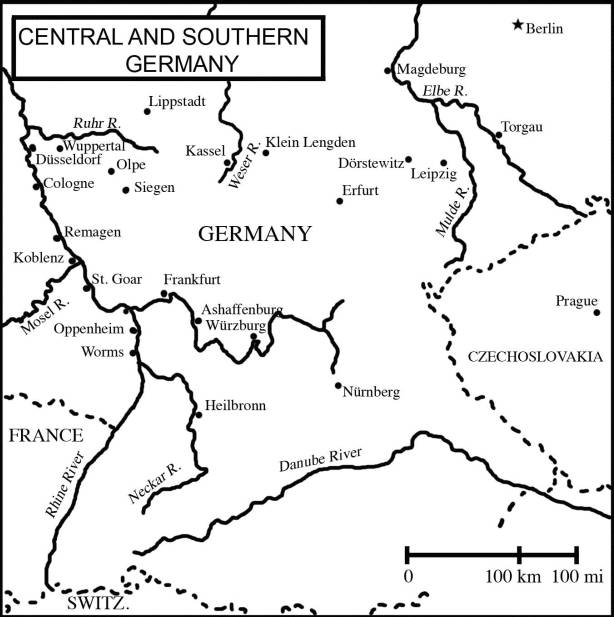 Spearheads Armored divisions rolled, and because
there were not enough to sweep everywhere, some infantry divisions
with their attached tank battalions joined the spearheads. Doughs
piled onto the tanks. In some cases, artillery observers rode with
the forward elements. Tank battalions attached to the infantry
divisions in the following wave spent their days scooping up
wandering German soldiers and clearing out the scattered towns and
villages where German forces refused to give up. On March
30, 3d Armored Division relayed orders to the
703d Tank Destroyer Battalion to support the attack by the division
on the road junction at Paderborn, the Fort Knox of the panzer arm.
German instructors, officer cadets, and trainees drove their
remaining tanks—including some sixty Tigers and Panthers from an SS
replacement battalion—out to contest the American advance, and
battle flared across the training grounds for two days.6 Task Force
Welborn formed one of the division’s two prongs and was advancing
near Etteln at dusk. The column had identified four Royal Tigers
ahead, but they had been struck by fighter-bombers, and Col. John
Welborn had been assured that the panzers had been knocked out. The
column advanced, and the very functional Tigers opened fire with
their deadly 88s. Seven Shermans were soon burning.7 The TDs
of 2d Platoon, Company B, returned fire and knocked out two Royal
Tigers—a job that required thirty-five rounds of AP and five of HE.
One 703d recon jeep was destroyed by return fire.8 During this
action, division commanding general Maj. Gen. Maurice Rose was
killed when he was cut off by four Royal Tigers. A panzer
commander, misinterpreting the general’s action, shot him when he
reached to drop his holster.9 Belton Cooper, in his history of the
3d Armored Division, reports that Royal Tigers destroyed an entire
company of Shermans from an unidentified task force and that one
M36 was lost during the debacle.10 The incident is not
mentioned in the division’s own history. Several sources concur
that one M36 was destroyed that day, but the exact circumstances
remain unclear. The 736th Tank Battalion (attached to the 83d
Infantry Division) was one of the units leading the charge. Their
column became engaged in an intense rivalry with the 2d Armored
Division to see who could move farthest fastest. The doughs
requisitioned every vehicle they came across (and one German ME-109
fighter plane, to boot, painting “83d Inf. Div.” across the
underside) and soon became known as the “Rag-Tag Circus.” The two
divisions reluctantly conceded a tie at the Weser River. Then, on
they pelted. The 2d Armored reached the Elbe River late on April 11
and slipped armored infantry across; doughs of the 83d Division
reached the east bank of the river on April 13. The
736th Battalion's tanks crossed the Elbe on April 20, but
Eisenhower had already decided that his troops would press no
closer to Berlin.11 This would be the farthest penetration for
a separate tank battalion in Germany. Advancing columns frequently
encountered small units that fought briefly, claiming a few more
American lives, before giving up, running, or dying. The SS were a
particular problem. American troops had a simple rule: If a town
showed white flags and offered no resistance, they rolled through
peacefully. If American troops came under fire, they smashed the
community. Indeed, any sympathy for the civilian populace declined
as advancing forces began liberating the concentration camps.
The 70th Tank Battalion’s informal history
recorded that “The tanks swept across open fields from village to
village, blasting relentlessly at every sign of resistance. Any
town or city that tried to delay the advance soon became a raging
inferno. The German landscape was dotted with burning villages.
More white flags began to appear.” 12 The brand-new German
Eleventh Army and its commander, General der
Infanterie Otto-Maximilian Hitzfeld, subordinated to Army
Group B, tried to put up a fight against XX Corps’ 80th Infantry Division at Kassel from
April 3 to 4. The “army” had been created out of the staff of XI
Corps and was to control LXVII, LXVI, and IX Corps.
Commander-in-Chief West Albert Kesselring personally oriented
Hitzfeld, heretofore commanding LXVII Corps, on his orders to both
break into the Ruhr Pocket to link up with the remnants of Army
Group B and use some elements to stop the American advance across
the Fulda. In terms of numbers, Eleventh Army looked like one of
the strongest armies in Germany. LXVI Corps on its right wing
consisted largely of an SS brigade that possessed up to 4,000 men
and thirty panzers, plus the 508th Heavy Tank Battalion with
between twenty and thirty Royal Tigers. LXVII Corps on the left had
the remnants of six infantry and volksgrenadier divisions, plus men
from the panzer non-commissioned officers school in Eisenach with
twenty panzers pulled from the Henschel works. These tanks had
given the 80th Division some trouble as it approached Kassel.
However, Eleventh Army had almost no reconnaissance capability,
artillery, supply structure, or fuel. It had no contact with
Seventh Army to its south and little idea what was going on to
either flank. Hitzfeld pondered his resources and immediately sent
a radio message to Kesselring’s headquarters requesting the attack
order be rescinded. He knew he could not stop the Americans—who he
apparently did not even know were from Third Army—in their advance
across the Fulda, and in fact probably could not even delay them.
His old corps had already given up bridgeheads across the Fulda
south of Kassel on April 3. U.S. First and Ninth Armies that same
day were smashing LXVI Corps.
Spearheads Armored divisions rolled, and because
there were not enough to sweep everywhere, some infantry divisions
with their attached tank battalions joined the spearheads. Doughs
piled onto the tanks. In some cases, artillery observers rode with
the forward elements. Tank battalions attached to the infantry
divisions in the following wave spent their days scooping up
wandering German soldiers and clearing out the scattered towns and
villages where German forces refused to give up. On March
30, 3d Armored Division relayed orders to the
703d Tank Destroyer Battalion to support the attack by the division
on the road junction at Paderborn, the Fort Knox of the panzer arm.
German instructors, officer cadets, and trainees drove their
remaining tanks—including some sixty Tigers and Panthers from an SS
replacement battalion—out to contest the American advance, and
battle flared across the training grounds for two days.6 Task Force
Welborn formed one of the division’s two prongs and was advancing
near Etteln at dusk. The column had identified four Royal Tigers
ahead, but they had been struck by fighter-bombers, and Col. John
Welborn had been assured that the panzers had been knocked out. The
column advanced, and the very functional Tigers opened fire with
their deadly 88s. Seven Shermans were soon burning.7 The TDs
of 2d Platoon, Company B, returned fire and knocked out two Royal
Tigers—a job that required thirty-five rounds of AP and five of HE.
One 703d recon jeep was destroyed by return fire.8 During this
action, division commanding general Maj. Gen. Maurice Rose was
killed when he was cut off by four Royal Tigers. A panzer
commander, misinterpreting the general’s action, shot him when he
reached to drop his holster.9 Belton Cooper, in his history of the
3d Armored Division, reports that Royal Tigers destroyed an entire
company of Shermans from an unidentified task force and that one
M36 was lost during the debacle.10 The incident is not
mentioned in the division’s own history. Several sources concur
that one M36 was destroyed that day, but the exact circumstances
remain unclear. The 736th Tank Battalion (attached to the 83d
Infantry Division) was one of the units leading the charge. Their
column became engaged in an intense rivalry with the 2d Armored
Division to see who could move farthest fastest. The doughs
requisitioned every vehicle they came across (and one German ME-109
fighter plane, to boot, painting “83d Inf. Div.” across the
underside) and soon became known as the “Rag-Tag Circus.” The two
divisions reluctantly conceded a tie at the Weser River. Then, on
they pelted. The 2d Armored reached the Elbe River late on April 11
and slipped armored infantry across; doughs of the 83d Division
reached the east bank of the river on April 13. The
736th Battalion's tanks crossed the Elbe on April 20, but
Eisenhower had already decided that his troops would press no
closer to Berlin.11 This would be the farthest penetration for
a separate tank battalion in Germany. Advancing columns frequently
encountered small units that fought briefly, claiming a few more
American lives, before giving up, running, or dying. The SS were a
particular problem. American troops had a simple rule: If a town
showed white flags and offered no resistance, they rolled through
peacefully. If American troops came under fire, they smashed the
community. Indeed, any sympathy for the civilian populace declined
as advancing forces began liberating the concentration camps.
The 70th Tank Battalion’s informal history
recorded that “The tanks swept across open fields from village to
village, blasting relentlessly at every sign of resistance. Any
town or city that tried to delay the advance soon became a raging
inferno. The German landscape was dotted with burning villages.
More white flags began to appear.” 12 The brand-new German
Eleventh Army and its commander, General der
Infanterie Otto-Maximilian Hitzfeld, subordinated to Army
Group B, tried to put up a fight against XX Corps’ 80th Infantry Division at Kassel from
April 3 to 4. The “army” had been created out of the staff of XI
Corps and was to control LXVII, LXVI, and IX Corps.
Commander-in-Chief West Albert Kesselring personally oriented
Hitzfeld, heretofore commanding LXVII Corps, on his orders to both
break into the Ruhr Pocket to link up with the remnants of Army
Group B and use some elements to stop the American advance across
the Fulda. In terms of numbers, Eleventh Army looked like one of
the strongest armies in Germany. LXVI Corps on its right wing
consisted largely of an SS brigade that possessed up to 4,000 men
and thirty panzers, plus the 508th Heavy Tank Battalion with
between twenty and thirty Royal Tigers. LXVII Corps on the left had
the remnants of six infantry and volksgrenadier divisions, plus men
from the panzer non-commissioned officers school in Eisenach with
twenty panzers pulled from the Henschel works. These tanks had
given the 80th Division some trouble as it approached Kassel.
However, Eleventh Army had almost no reconnaissance capability,
artillery, supply structure, or fuel. It had no contact with
Seventh Army to its south and little idea what was going on to
either flank. Hitzfeld pondered his resources and immediately sent
a radio message to Kesselring’s headquarters requesting the attack
order be rescinded. He knew he could not stop the Americans—who he
apparently did not even know were from Third Army—in their advance
across the Fulda, and in fact probably could not even delay them.
His old corps had already given up bridgeheads across the Fulda
south of Kassel on April 3. U.S. First and Ninth Armies that same
day were smashing LXVI Corps. 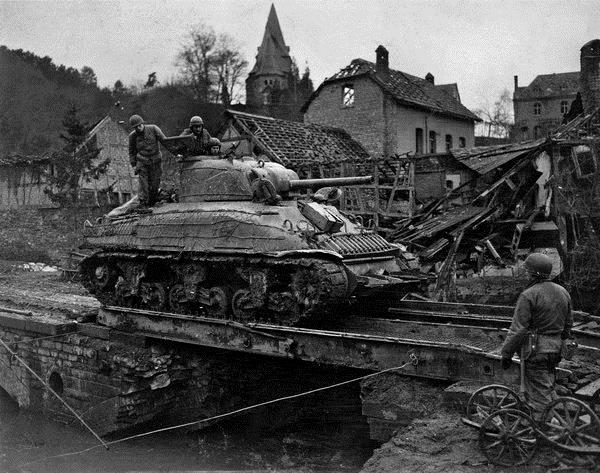 The 80th Division on April 4 entered Kassel. The
last radio message from the commander of the city’s defenses said,
“Surrounded with the remnants of the garrison in the Truselturm
[city center]. No ammunition, no water.” The commander surrendered
with 400 men. Kesselring appeared again and told Hitzfeld the
attack toward the Ruhr was off. Instead, he was to attack the Third
Army’s flank at Eisenach. LXVII Corps by the evening of April 6
assembled some thirty tanks and assault guns and two battalions of
infantry at Mülhausen to attack as ordered. The strike group moved
out on the 7th, only to be shredded by fighter-bombers, the
fearedjabos. Third Army nevertheless credited LXVII Corps with
conducting a well-coordinated operation but had no idea which
German unit was involved. The survivors retreated, and thus ended
Eleventh Army’s real fight with Patton. Under the command
of General der Artillerie Walther Lucht from April 7 to
20, it continued to be a notional presence because its zone was
extended to include Erfurt and Weimar, both of which Third Army
easily captured, the latter without a fight.13 The 702d Tank Battalion, dashing through central
Germany with the 80th Infantry Division, described in its
after-action report the conditions tankers of most units
encountered much of the time: Throughout the month of April, enemy
attempts at resistance were marked by their continued feebleness.
At only two periods was there any show of strength, and by late in
the month our assault had lost its character, and the only proper
description for operations engaged in by the battalion was “road
march”. The cities of Kassel and Erfurt were the focal points of
resistance, and in the defense of the former, tanks were used in
limited numbers. Flak units were the manpower basis for this
defense. But these fanatical sacrifice operations served to no
value, for the miscellaneous grab-bag units crumbled before our
organized assaults after only a token-plus resistance... The
attitude of the German soldier was one of complete abandonment to
his fate. He found his fate lay only in two directions, death or
the PW camp, and with a little physical persuasion, generally chose
the latter. PW figures grew astronomically, and interrogation
degenerated into a simple counting of those who passed through the
tills of the PW cage. The German people were completely confused
and confusing. Many of them went out of their way to be hospitable
to the conquering American, and overt acts by the civilians against
our military forces were rare.14 General der
Panzertruppe Smilo Freiherr von Lüttwitz on March 29
received orders to activate the remnants of LXXXV Corps
headquarters and assume control of the Werra sector on April 1.
Lüttwitz found he had at his disposal the redoubtable 11thPanzer
Division, still at 50-percent strength, including 20 to
25 Panthers and Mark IVs, and with good communications. He
also had a Kampfgruppe from the armored troops school
with five panzers and fragments of three infantry divisions. A
panzergrenadier regiment of the 11th Panzer Division supported
by 12 panzers formed his only reserve. The corps was to
hold U.S. XII Corps before Eisenach and block entry into the
Thuringian Forest, and as best as Lüttwitz could understand the
situation, the 4th Armored and 90th Infantry divisions would arrive
in his zone in the near future. Lüttwitz planned to wage a flexible
defense. He kept the 11th Panzer Division southeast of
Eisenach, ready to reinforce an imperiled part of his line or to
counterattack any breakthrough. The instincts were still there, but
the means were not. Lüttwitz described the last serious effort by
any German commander to fight: The north wing appeared to be
particularly endangered because there was the boundary of the army
group and a loose communication with the units to the north of
Kreuzburg existed only temporarily. Because of inadequate radio
equipment available, signal communications to [Seventh] Army as
well as to subordinate and neighboring units had to be established
by using the postal telephone wire net, which was mostly
overburdened and therefore frequently failed to transmit. At the
Werra sector, only light field positions had been built during the
short lapse of time, and only small defense sectors in depth along
the main roads. But artillery and antitank defense for an efficient
defense were entirely lacking... By using heavy screening smoke,
the American forces crossed the Werra at Kreuzburg and south of it
early in the morning of April 4. From the bridgehead newly formed
by infantry, the spearhead of the American 4th Armored
Division thrust past the north of Eisenach to the east [...] In the
afternoon of the 4th, the American 90th Infantry Division
attacked on a wide front against the sector south of
Eisenach [...] During these engagements, the corps
(exclusive of the 11th Panzer Division) lost about 60 percent
of its fighting strength. [Lüttwitz had been forced to commit
the 11th Panzer Division on his right flank and so it was not
available to counterattack as he had planned. By April 9, all
formations subordinate to the corps had been annihilated except for
Wietersheim’s division.]15 Responding in part to the “extremely
stubborn” resistance at Eisenach, the Third Army G-2 Oscar Koch
observed, “Apparently as long as the German High Command is able to
conjure up personnel that will submit to commitment it is the
purpose of the High Command to wage war [...] The bulk of
the enemy’s armies have been shattered and his industrial power to
continue large-scale warfare has been either destroyed or captured.
But his will to fight and fanatical ingenuity to inflict losses on
us are unshaken. The enemy is comparable to a mad beast at
bay—wounded to the death but still deadly dangerous.” On April 11,
Koch judged that some 16,000 men and perhaps ninety tanks and
assault guns opposed the quarter-million men of Third Army.16
Indeed, now and again, the fights were big and dismaying.
Aschaffenburg On March 28, the 45th Infantry Division arrived at
Aschaffenburg, which proved to be the first of several tough urban
battles. Army Group G was attempting to construct a line along the
Main River and had transferred LXXXV Corps from First to Seventh
Army to execute the mission. OKW had ordered the
413th Division, slapped together from training units, to
reinforce positions north and south of Aschaffenburg. The army
group was hurriedly refitting the 36th Infantry and
17th SS Panzergrenadier divisions from its dwindling stocks
and planned to bring them forward as soon as possible.17
The 80th Division on April 4 entered Kassel. The
last radio message from the commander of the city’s defenses said,
“Surrounded with the remnants of the garrison in the Truselturm
[city center]. No ammunition, no water.” The commander surrendered
with 400 men. Kesselring appeared again and told Hitzfeld the
attack toward the Ruhr was off. Instead, he was to attack the Third
Army’s flank at Eisenach. LXVII Corps by the evening of April 6
assembled some thirty tanks and assault guns and two battalions of
infantry at Mülhausen to attack as ordered. The strike group moved
out on the 7th, only to be shredded by fighter-bombers, the
fearedjabos. Third Army nevertheless credited LXVII Corps with
conducting a well-coordinated operation but had no idea which
German unit was involved. The survivors retreated, and thus ended
Eleventh Army’s real fight with Patton. Under the command
of General der Artillerie Walther Lucht from April 7 to
20, it continued to be a notional presence because its zone was
extended to include Erfurt and Weimar, both of which Third Army
easily captured, the latter without a fight.13 The 702d Tank Battalion, dashing through central
Germany with the 80th Infantry Division, described in its
after-action report the conditions tankers of most units
encountered much of the time: Throughout the month of April, enemy
attempts at resistance were marked by their continued feebleness.
At only two periods was there any show of strength, and by late in
the month our assault had lost its character, and the only proper
description for operations engaged in by the battalion was “road
march”. The cities of Kassel and Erfurt were the focal points of
resistance, and in the defense of the former, tanks were used in
limited numbers. Flak units were the manpower basis for this
defense. But these fanatical sacrifice operations served to no
value, for the miscellaneous grab-bag units crumbled before our
organized assaults after only a token-plus resistance... The
attitude of the German soldier was one of complete abandonment to
his fate. He found his fate lay only in two directions, death or
the PW camp, and with a little physical persuasion, generally chose
the latter. PW figures grew astronomically, and interrogation
degenerated into a simple counting of those who passed through the
tills of the PW cage. The German people were completely confused
and confusing. Many of them went out of their way to be hospitable
to the conquering American, and overt acts by the civilians against
our military forces were rare.14 General der
Panzertruppe Smilo Freiherr von Lüttwitz on March 29
received orders to activate the remnants of LXXXV Corps
headquarters and assume control of the Werra sector on April 1.
Lüttwitz found he had at his disposal the redoubtable 11thPanzer
Division, still at 50-percent strength, including 20 to
25 Panthers and Mark IVs, and with good communications. He
also had a Kampfgruppe from the armored troops school
with five panzers and fragments of three infantry divisions. A
panzergrenadier regiment of the 11th Panzer Division supported
by 12 panzers formed his only reserve. The corps was to
hold U.S. XII Corps before Eisenach and block entry into the
Thuringian Forest, and as best as Lüttwitz could understand the
situation, the 4th Armored and 90th Infantry divisions would arrive
in his zone in the near future. Lüttwitz planned to wage a flexible
defense. He kept the 11th Panzer Division southeast of
Eisenach, ready to reinforce an imperiled part of his line or to
counterattack any breakthrough. The instincts were still there, but
the means were not. Lüttwitz described the last serious effort by
any German commander to fight: The north wing appeared to be
particularly endangered because there was the boundary of the army
group and a loose communication with the units to the north of
Kreuzburg existed only temporarily. Because of inadequate radio
equipment available, signal communications to [Seventh] Army as
well as to subordinate and neighboring units had to be established
by using the postal telephone wire net, which was mostly
overburdened and therefore frequently failed to transmit. At the
Werra sector, only light field positions had been built during the
short lapse of time, and only small defense sectors in depth along
the main roads. But artillery and antitank defense for an efficient
defense were entirely lacking... By using heavy screening smoke,
the American forces crossed the Werra at Kreuzburg and south of it
early in the morning of April 4. From the bridgehead newly formed
by infantry, the spearhead of the American 4th Armored
Division thrust past the north of Eisenach to the east [...] In the
afternoon of the 4th, the American 90th Infantry Division
attacked on a wide front against the sector south of
Eisenach [...] During these engagements, the corps
(exclusive of the 11th Panzer Division) lost about 60 percent
of its fighting strength. [Lüttwitz had been forced to commit
the 11th Panzer Division on his right flank and so it was not
available to counterattack as he had planned. By April 9, all
formations subordinate to the corps had been annihilated except for
Wietersheim’s division.]15 Responding in part to the “extremely
stubborn” resistance at Eisenach, the Third Army G-2 Oscar Koch
observed, “Apparently as long as the German High Command is able to
conjure up personnel that will submit to commitment it is the
purpose of the High Command to wage war [...] The bulk of
the enemy’s armies have been shattered and his industrial power to
continue large-scale warfare has been either destroyed or captured.
But his will to fight and fanatical ingenuity to inflict losses on
us are unshaken. The enemy is comparable to a mad beast at
bay—wounded to the death but still deadly dangerous.” On April 11,
Koch judged that some 16,000 men and perhaps ninety tanks and
assault guns opposed the quarter-million men of Third Army.16
Indeed, now and again, the fights were big and dismaying.
Aschaffenburg On March 28, the 45th Infantry Division arrived at
Aschaffenburg, which proved to be the first of several tough urban
battles. Army Group G was attempting to construct a line along the
Main River and had transferred LXXXV Corps from First to Seventh
Army to execute the mission. OKW had ordered the
413th Division, slapped together from training units, to
reinforce positions north and south of Aschaffenburg. The army
group was hurriedly refitting the 36th Infantry and
17th SS Panzergrenadier divisions from its dwindling stocks
and planned to bring them forward as soon as possible.17 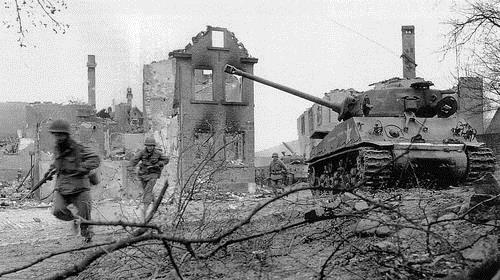 The 45th Division crossed to the east bank of the
Main River and found an organized defense anchored in pillboxes and
trenches and backed by artillery and mortars. The GIs encountered
elements they initially identified as the 553d Volksgrenadier
Division, although a German account indicates the troops belonged
to the 413th Division. The 2d Battalion, 157th Infantry
Regiment, which had crossed the Main over a railroad bridge,
attacked Aschaffenburg, where it encountered heavy small-arms,
machine-gun, and antitank fire that slowed the advance to a
painstaking crawl.18 After getting a first taste of the resistance,
the division reported that an estimated 3,500 “Krauts” were in
Aschaffenburg.19 The division’s AAR records the following for
March 29: “Enemy resistance [...] soared to a peak of
fanaticism [...] Civilians without [Volkssturm, or
militia] armbands fighting in Schweinheim and Aschaffenburg
necessitated searching every house and building. Enemy
reinforcements arrived steadily, and elements of the
36th Infantry Division were identified. Many of the enemy
soldiers were 16- and 17-year-old boys who refused to surrender and
had to be killed in their foxholes and trenches.” The division’s
history added, “[Garrison commander] Major von Lambert
organized old men, women, and young girls to resist the division’s
advance. They hurled grenades from roofs and second-story
buildings.” (Von Lambert had permitted all civilians who wished to
leave to do so by March 29.) The 2d Battalion pounded
Aschaffenburg while tank destroyers fired at a church steeple
serving as an OP and at strongpoints, and numerous fires flared
around the city. The 3d Battalion struggled to clear nearby
Schweinheim to open a route that would allow the regiment to
envelop Ashaffenburg from the east. Three battalion-size
counterattacks hit the Americans in the course of the day before
the Germans withdrew to the northern part of town. Commanders
ordered up air strikes against targets in Aschaffenburg the next
day, including von Lambert’s headquarters in the Gestapo building,
and a chemical mortar battalion rained white phosphorus on the
city, igniting yet more blazes. The 3d Battalion managed to reach
the last row of houses in Schweinheim by dusk, but German troops
reinfiltrated behind the Americans. As a result, when the 2d
Battalion moved forward for a day of house-to-house fighting in
Aschaffenburg, the 3d Battalion had to refight the battle in
Schweinheim. Finally, on April 2, the regiment was able to
commit all three of its battalions to Aschaffenburg, which
continued to shudder under air and artillery bombardment. 155mm
self-propelled guns were brought into the city to fire point-blank
into buildings. At 0900 hours on April 3, von Lambert approached
the lines of the 2d Battalion and capitulated. One German officer
estimated that the defenders had suffered 1,500 personnel killed
and wounded, and another 3,000 were taken prisoner. The GIs,
recalling their toughest fight in Italy, henceforth called the
ruined city “Cassino-on-the-Main.”20 The Germans had expended
almost everything they had in front of XV Corps at Aschaffenburg.
From here, the Americans would encounter almost no organized
resistance until they had reached Nürnberg.21 Irreparable
holes had emerged between Army Groups G and B, and between the
armies within Army Group G.22 Heilbronn After Seventh Army crossed
the Rhine, the 100th Infantry Division and
the 781st Tank Battalion advanced rapidly
until reaching the west bank of the Neckar River in the vicinity of
Heilbronn on April 3. The doughs crossed the river in assault boats
the next day to find themselves battling a remarkably effective
defense made up of Wehrmacht, Volksturm, Hitler Youth, and SS—so
effective that the Germans counterattacked and almost threw the
doughs back into the Neckar. Accurate artillery fire disrupted
every American attempt to erect a bridge and get the tanks across.
Higher headquarters frantically arranged for the delivery of
10 DD Shermans to the 781st Tank Battalion, and crews
were given a day of training. The tanks entered the water but were
unable to climb the other side, and three sank. Finally, on April
8, two platoons made the trip across a temporary bridge that was
immediately knocked out by enemy artillery. On April 12, American
doughs and tanks pushed the German artillery out of range of the
bridging sites, and on the next day Heilbronn fell.23
The 45th Division crossed to the east bank of the
Main River and found an organized defense anchored in pillboxes and
trenches and backed by artillery and mortars. The GIs encountered
elements they initially identified as the 553d Volksgrenadier
Division, although a German account indicates the troops belonged
to the 413th Division. The 2d Battalion, 157th Infantry
Regiment, which had crossed the Main over a railroad bridge,
attacked Aschaffenburg, where it encountered heavy small-arms,
machine-gun, and antitank fire that slowed the advance to a
painstaking crawl.18 After getting a first taste of the resistance,
the division reported that an estimated 3,500 “Krauts” were in
Aschaffenburg.19 The division’s AAR records the following for
March 29: “Enemy resistance [...] soared to a peak of
fanaticism [...] Civilians without [Volkssturm, or
militia] armbands fighting in Schweinheim and Aschaffenburg
necessitated searching every house and building. Enemy
reinforcements arrived steadily, and elements of the
36th Infantry Division were identified. Many of the enemy
soldiers were 16- and 17-year-old boys who refused to surrender and
had to be killed in their foxholes and trenches.” The division’s
history added, “[Garrison commander] Major von Lambert
organized old men, women, and young girls to resist the division’s
advance. They hurled grenades from roofs and second-story
buildings.” (Von Lambert had permitted all civilians who wished to
leave to do so by March 29.) The 2d Battalion pounded
Aschaffenburg while tank destroyers fired at a church steeple
serving as an OP and at strongpoints, and numerous fires flared
around the city. The 3d Battalion struggled to clear nearby
Schweinheim to open a route that would allow the regiment to
envelop Ashaffenburg from the east. Three battalion-size
counterattacks hit the Americans in the course of the day before
the Germans withdrew to the northern part of town. Commanders
ordered up air strikes against targets in Aschaffenburg the next
day, including von Lambert’s headquarters in the Gestapo building,
and a chemical mortar battalion rained white phosphorus on the
city, igniting yet more blazes. The 3d Battalion managed to reach
the last row of houses in Schweinheim by dusk, but German troops
reinfiltrated behind the Americans. As a result, when the 2d
Battalion moved forward for a day of house-to-house fighting in
Aschaffenburg, the 3d Battalion had to refight the battle in
Schweinheim. Finally, on April 2, the regiment was able to
commit all three of its battalions to Aschaffenburg, which
continued to shudder under air and artillery bombardment. 155mm
self-propelled guns were brought into the city to fire point-blank
into buildings. At 0900 hours on April 3, von Lambert approached
the lines of the 2d Battalion and capitulated. One German officer
estimated that the defenders had suffered 1,500 personnel killed
and wounded, and another 3,000 were taken prisoner. The GIs,
recalling their toughest fight in Italy, henceforth called the
ruined city “Cassino-on-the-Main.”20 The Germans had expended
almost everything they had in front of XV Corps at Aschaffenburg.
From here, the Americans would encounter almost no organized
resistance until they had reached Nürnberg.21 Irreparable
holes had emerged between Army Groups G and B, and between the
armies within Army Group G.22 Heilbronn After Seventh Army crossed
the Rhine, the 100th Infantry Division and
the 781st Tank Battalion advanced rapidly
until reaching the west bank of the Neckar River in the vicinity of
Heilbronn on April 3. The doughs crossed the river in assault boats
the next day to find themselves battling a remarkably effective
defense made up of Wehrmacht, Volksturm, Hitler Youth, and SS—so
effective that the Germans counterattacked and almost threw the
doughs back into the Neckar. Accurate artillery fire disrupted
every American attempt to erect a bridge and get the tanks across.
Higher headquarters frantically arranged for the delivery of
10 DD Shermans to the 781st Tank Battalion, and crews
were given a day of training. The tanks entered the water but were
unable to climb the other side, and three sank. Finally, on April
8, two platoons made the trip across a temporary bridge that was
immediately knocked out by enemy artillery. On April 12, American
doughs and tanks pushed the German artillery out of range of the
bridging sites, and on the next day Heilbronn fell.23 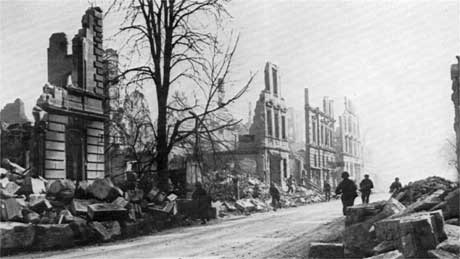 Crailsheim Also in Seventh Army, a 10th Armored Division envelopment
operation turned into a bit of a fiasco. Combat Command A easily
rolled 30 miles into Crailsheim on April 6, where a task force
occupied the town while two others pressed on. Small groups of
German troops, probably from the 1st Alpine
Regiment that had by chance just arrived in the area, slipped
behind the command and closed the single narrow road that was the
armored outfit’s supply line. Perhaps because the Luftwaffe saw no
point in hoarding fuel or aircraft, air strikes by German
fighter-bombers increased as Allied forces progressed deeper into
the Reich. Me-110 bombing runs against the troops in Crailsheim
that day suggested that there was still some coordination going on
with ground forces, and more air attacks in support of ground
assaults took place over the next several days. “For four days,”
noted Stars and Stripes, “the fighting at the tip of the
Crailsheim finger was the most bitter along the Western front.”
Brooks had to commit CCB from corps reserve along with a cavalry
squadron and an infantry regiment from the 44thInfantry division to
flush the German combat groups from the length of the road and the
villages along side it, which took until April 10. Inside
Crailsheim, as many as 700 SS troopers from a school at Ellwangen
attacked Combat Command A on April 8 from three directions and
inflicted numerous casualties. When 60 C-47 transports were
ordered to land at the captured Crailsheim airfield to deliver
supplies and evacuate casualties on April 9, German fighter-bombers
appeared and strafed and bombed the aerodrome. A battalion-size SS
force attacked the Americans again on April 10. Once the
10th Armored Division linked up with the 63d Infantry
Division, which had also had a rough time with the SS, it abandoned
Crailsheim rather than fight to hold the unimportant town. Within a
day after Heilbronn’s capture, the SS had largely been wiped out or
slipped away.24 According to a fairly substantial body of German
post-war accounts, after this and other stiff actions involving the
SS—at a time when the war was clearly lost, and GIs increasingly
resented the idea of being killed for no good reason—some American
troops summarily executed groups of captured SS men.25 It is
possible that the liberation of a growing number of concentration
camps also contributed to these ugly violations of the rules of
war. Nürnberg On April 17, the 756th Tank Battalion rolled into the
Nazi citadel of Nürnberg, and with the doughs of the 3d Infantry Division for three days fought
street to street against determined resistance in the form of
antitank, bazooka, and small-arms fire. The 191stTank Battalion and
45th Infantry Division pushed in from the south. SS and
mountain troops, backed by 35 tanks brought from the
Grafenwoehr Proving Grounds, defended the city. German snipers with
panzerfausts picked off tanks from the rooftops, and it became
standard practice for the tanks to blast any building that even
looked as if it might hide such a sniper. On April 22, with victory
finally at hand, the 756th Tank Battalion patrolled the
streets of the city in a show of strength.26 1Third Army G-2
periodic report, 17 March 1945. 2Third Army G-2 periodic report, 31
March 1945. Army Ground Forces Report No 808, “Tank Destroyer
Information Letter No 8,” 4 April 1945. 3Cornelius Ryan, The
Last Battle (New York: Simon and Schuster, 1966), 280.
(Hereafter Ryan.) 4AAR, 737th Tank Battalion. 5Griess, 406–407
6Ibid., 352. Wilmot, 684. 7Charles Whiting, The Battle of the
Ruhr Pocket (New York, NY: Ballentine Books Inc, 1970), 62-63.
(Hereinafter Whiting, The Battle of the Ruhr Pocket.) 8S-3
Journal, 703d Tank Destroyer Battalion. 9MacDonald, The
Last Offensive, 352. 10Cooper, 254-256. 11Ryan, 285 ff;
Macdonald, The Last Offensive, 387. AAR, 736th Tank Battalion.
AAR, 709th Tank Battalion. 12Soixante-Dix.
13Schramm, Kriegstagebuch der OKW, 1. Januar 1944—22 Mai
1945, Zweiter Halbband, Band 4, 1225ff. Oberst Fritz
Estor, “Kaempfe der 11. Armee April 1945 in Mitteldeutschland,” MS
# B-581, 3 January 1947, National Archives, passim. Third Army G-2
periodic report, 1-12 April 1945. 14AAR, April 1945, 702d Tank
Battalion. 15General der Panzertruppe Smilo Freiherr von
Lüttwitz, “Combat Report of the LXXXV. ‘Armeekorps’,” MS # B-617,
June 1947, National Archives, 1ff. (Hereafter Lüttwitz, “Combat
Report of the LXXXV. ‘Armeekorps’.”) 16Third Army G-2 periodic
reports, 5 and 11 April 1945. 17Wilutzky, “The Final Battle.”
18AAR, 45th Infantry Division. 19G-3 journal, VI Corps. 20AAR, 45th
Infantry Division. The Fighting Forty-Fifth, 162 ff. 21G-2
history, Seventh Army. 22Wilutzky, “The Final Battle.” 23Battalion
history, 781st Tank Battalion. Up From Marseille, 22; Whiting,
193 ff. 24Report of operations, Seventh Army. Battalion history,
781st Tank Battalion; Up From Marseille, 22; Whiting,
Whiting,America’s Forgotten Army, 193 ff. G-3 journal, VI Corps.
Wilutzky, “The Final Battle.” Terrify and Destroy: The Story
of the 10th Armored Division (Paris: Stars and Stripes,
1945). Generalmajor Wolf-Rüdiger Hauser, “Report on the
Combat Engagements Within the Framework of the First Army During
the Period From 24 March to 2 May 1945,” MS # B-348, 12 September
1946, National Archives. (Hereafter Hauser.) 25Search for
“warcrimes,” Axis History Forum, www.axishistory.com. 26AAR, 756th
Tank Battalion; Whiting, 197 ff.
Crailsheim Also in Seventh Army, a 10th Armored Division envelopment
operation turned into a bit of a fiasco. Combat Command A easily
rolled 30 miles into Crailsheim on April 6, where a task force
occupied the town while two others pressed on. Small groups of
German troops, probably from the 1st Alpine
Regiment that had by chance just arrived in the area, slipped
behind the command and closed the single narrow road that was the
armored outfit’s supply line. Perhaps because the Luftwaffe saw no
point in hoarding fuel or aircraft, air strikes by German
fighter-bombers increased as Allied forces progressed deeper into
the Reich. Me-110 bombing runs against the troops in Crailsheim
that day suggested that there was still some coordination going on
with ground forces, and more air attacks in support of ground
assaults took place over the next several days. “For four days,”
noted Stars and Stripes, “the fighting at the tip of the
Crailsheim finger was the most bitter along the Western front.”
Brooks had to commit CCB from corps reserve along with a cavalry
squadron and an infantry regiment from the 44thInfantry division to
flush the German combat groups from the length of the road and the
villages along side it, which took until April 10. Inside
Crailsheim, as many as 700 SS troopers from a school at Ellwangen
attacked Combat Command A on April 8 from three directions and
inflicted numerous casualties. When 60 C-47 transports were
ordered to land at the captured Crailsheim airfield to deliver
supplies and evacuate casualties on April 9, German fighter-bombers
appeared and strafed and bombed the aerodrome. A battalion-size SS
force attacked the Americans again on April 10. Once the
10th Armored Division linked up with the 63d Infantry
Division, which had also had a rough time with the SS, it abandoned
Crailsheim rather than fight to hold the unimportant town. Within a
day after Heilbronn’s capture, the SS had largely been wiped out or
slipped away.24 According to a fairly substantial body of German
post-war accounts, after this and other stiff actions involving the
SS—at a time when the war was clearly lost, and GIs increasingly
resented the idea of being killed for no good reason—some American
troops summarily executed groups of captured SS men.25 It is
possible that the liberation of a growing number of concentration
camps also contributed to these ugly violations of the rules of
war. Nürnberg On April 17, the 756th Tank Battalion rolled into the
Nazi citadel of Nürnberg, and with the doughs of the 3d Infantry Division for three days fought
street to street against determined resistance in the form of
antitank, bazooka, and small-arms fire. The 191stTank Battalion and
45th Infantry Division pushed in from the south. SS and
mountain troops, backed by 35 tanks brought from the
Grafenwoehr Proving Grounds, defended the city. German snipers with
panzerfausts picked off tanks from the rooftops, and it became
standard practice for the tanks to blast any building that even
looked as if it might hide such a sniper. On April 22, with victory
finally at hand, the 756th Tank Battalion patrolled the
streets of the city in a show of strength.26 1Third Army G-2
periodic report, 17 March 1945. 2Third Army G-2 periodic report, 31
March 1945. Army Ground Forces Report No 808, “Tank Destroyer
Information Letter No 8,” 4 April 1945. 3Cornelius Ryan, The
Last Battle (New York: Simon and Schuster, 1966), 280.
(Hereafter Ryan.) 4AAR, 737th Tank Battalion. 5Griess, 406–407
6Ibid., 352. Wilmot, 684. 7Charles Whiting, The Battle of the
Ruhr Pocket (New York, NY: Ballentine Books Inc, 1970), 62-63.
(Hereinafter Whiting, The Battle of the Ruhr Pocket.) 8S-3
Journal, 703d Tank Destroyer Battalion. 9MacDonald, The
Last Offensive, 352. 10Cooper, 254-256. 11Ryan, 285 ff;
Macdonald, The Last Offensive, 387. AAR, 736th Tank Battalion.
AAR, 709th Tank Battalion. 12Soixante-Dix.
13Schramm, Kriegstagebuch der OKW, 1. Januar 1944—22 Mai
1945, Zweiter Halbband, Band 4, 1225ff. Oberst Fritz
Estor, “Kaempfe der 11. Armee April 1945 in Mitteldeutschland,” MS
# B-581, 3 January 1947, National Archives, passim. Third Army G-2
periodic report, 1-12 April 1945. 14AAR, April 1945, 702d Tank
Battalion. 15General der Panzertruppe Smilo Freiherr von
Lüttwitz, “Combat Report of the LXXXV. ‘Armeekorps’,” MS # B-617,
June 1947, National Archives, 1ff. (Hereafter Lüttwitz, “Combat
Report of the LXXXV. ‘Armeekorps’.”) 16Third Army G-2 periodic
reports, 5 and 11 April 1945. 17Wilutzky, “The Final Battle.”
18AAR, 45th Infantry Division. 19G-3 journal, VI Corps. 20AAR, 45th
Infantry Division. The Fighting Forty-Fifth, 162 ff. 21G-2
history, Seventh Army. 22Wilutzky, “The Final Battle.” 23Battalion
history, 781st Tank Battalion. Up From Marseille, 22; Whiting,
193 ff. 24Report of operations, Seventh Army. Battalion history,
781st Tank Battalion; Up From Marseille, 22; Whiting,
Whiting,America’s Forgotten Army, 193 ff. G-3 journal, VI Corps.
Wilutzky, “The Final Battle.” Terrify and Destroy: The Story
of the 10th Armored Division (Paris: Stars and Stripes,
1945). Generalmajor Wolf-Rüdiger Hauser, “Report on the
Combat Engagements Within the Framework of the First Army During
the Period From 24 March to 2 May 1945,” MS # B-348, 12 September
1946, National Archives. (Hereafter Hauser.) 25Search for
“warcrimes,” Axis History Forum, www.axishistory.com. 26AAR, 756th
Tank Battalion; Whiting, 197 ff.
Spearheads Armored divisions rolled, and because
there were not enough to sweep everywhere, some infantry divisions
with their attached tank battalions joined the spearheads. Doughs
piled onto the tanks. In some cases, artillery observers rode with
the forward elements. Tank battalions attached to the infantry
divisions in the following wave spent their days scooping up
wandering German soldiers and clearing out the scattered towns and
villages where German forces refused to give up. On March
30, 3d Armored Division relayed orders to the
703d Tank Destroyer Battalion to support the attack by the division
on the road junction at Paderborn, the Fort Knox of the panzer arm.
German instructors, officer cadets, and trainees drove their
remaining tanks—including some sixty Tigers and Panthers from an SS
replacement battalion—out to contest the American advance, and
battle flared across the training grounds for two days.6 Task Force
Welborn formed one of the division’s two prongs and was advancing
near Etteln at dusk. The column had identified four Royal Tigers
ahead, but they had been struck by fighter-bombers, and Col. John
Welborn had been assured that the panzers had been knocked out. The
column advanced, and the very functional Tigers opened fire with
their deadly 88s. Seven Shermans were soon burning.7 The TDs
of 2d Platoon, Company B, returned fire and knocked out two Royal
Tigers—a job that required thirty-five rounds of AP and five of HE.
One 703d recon jeep was destroyed by return fire.8 During this
action, division commanding general Maj. Gen. Maurice Rose was
killed when he was cut off by four Royal Tigers. A panzer
commander, misinterpreting the general’s action, shot him when he
reached to drop his holster.9 Belton Cooper, in his history of the
3d Armored Division, reports that Royal Tigers destroyed an entire
company of Shermans from an unidentified task force and that one
M36 was lost during the debacle.10 The incident is not
mentioned in the division’s own history. Several sources concur
that one M36 was destroyed that day, but the exact circumstances
remain unclear. The 736th Tank Battalion (attached to the 83d
Infantry Division) was one of the units leading the charge. Their
column became engaged in an intense rivalry with the 2d Armored
Division to see who could move farthest fastest. The doughs
requisitioned every vehicle they came across (and one German ME-109
fighter plane, to boot, painting “83d Inf. Div.” across the
underside) and soon became known as the “Rag-Tag Circus.” The two
divisions reluctantly conceded a tie at the Weser River. Then, on
they pelted. The 2d Armored reached the Elbe River late on April 11
and slipped armored infantry across; doughs of the 83d Division
reached the east bank of the river on April 13. The
736th Battalion's tanks crossed the Elbe on April 20, but
Eisenhower had already decided that his troops would press no
closer to Berlin.11 This would be the farthest penetration for
a separate tank battalion in Germany. Advancing columns frequently
encountered small units that fought briefly, claiming a few more
American lives, before giving up, running, or dying. The SS were a
particular problem. American troops had a simple rule: If a town
showed white flags and offered no resistance, they rolled through
peacefully. If American troops came under fire, they smashed the
community. Indeed, any sympathy for the civilian populace declined
as advancing forces began liberating the concentration camps.
The 70th Tank Battalion’s informal history
recorded that “The tanks swept across open fields from village to
village, blasting relentlessly at every sign of resistance. Any
town or city that tried to delay the advance soon became a raging
inferno. The German landscape was dotted with burning villages.
More white flags began to appear.” 12 The brand-new German
Eleventh Army and its commander, General der
Infanterie Otto-Maximilian Hitzfeld, subordinated to Army
Group B, tried to put up a fight against XX Corps’ 80th Infantry Division at Kassel from
April 3 to 4. The “army” had been created out of the staff of XI
Corps and was to control LXVII, LXVI, and IX Corps.
Commander-in-Chief West Albert Kesselring personally oriented
Hitzfeld, heretofore commanding LXVII Corps, on his orders to both
break into the Ruhr Pocket to link up with the remnants of Army
Group B and use some elements to stop the American advance across
the Fulda. In terms of numbers, Eleventh Army looked like one of
the strongest armies in Germany. LXVI Corps on its right wing
consisted largely of an SS brigade that possessed up to 4,000 men
and thirty panzers, plus the 508th Heavy Tank Battalion with
between twenty and thirty Royal Tigers. LXVII Corps on the left had
the remnants of six infantry and volksgrenadier divisions, plus men
from the panzer non-commissioned officers school in Eisenach with
twenty panzers pulled from the Henschel works. These tanks had
given the 80th Division some trouble as it approached Kassel.
However, Eleventh Army had almost no reconnaissance capability,
artillery, supply structure, or fuel. It had no contact with
Seventh Army to its south and little idea what was going on to
either flank. Hitzfeld pondered his resources and immediately sent
a radio message to Kesselring’s headquarters requesting the attack
order be rescinded. He knew he could not stop the Americans—who he
apparently did not even know were from Third Army—in their advance
across the Fulda, and in fact probably could not even delay them.
His old corps had already given up bridgeheads across the Fulda
south of Kassel on April 3. U.S. First and Ninth Armies that same
day were smashing LXVI Corps. The 80th Division on April 4 entered Kassel. The
last radio message from the commander of the city’s defenses said,
“Surrounded with the remnants of the garrison in the Truselturm
[city center]. No ammunition, no water.” The commander surrendered
with 400 men. Kesselring appeared again and told Hitzfeld the
attack toward the Ruhr was off. Instead, he was to attack the Third
Army’s flank at Eisenach. LXVII Corps by the evening of April 6
assembled some thirty tanks and assault guns and two battalions of
infantry at Mülhausen to attack as ordered. The strike group moved
out on the 7th, only to be shredded by fighter-bombers, the
fearedjabos. Third Army nevertheless credited LXVII Corps with
conducting a well-coordinated operation but had no idea which
German unit was involved. The survivors retreated, and thus ended
Eleventh Army’s real fight with Patton. Under the command
of General der Artillerie Walther Lucht from April 7 to
20, it continued to be a notional presence because its zone was
extended to include Erfurt and Weimar, both of which Third Army
easily captured, the latter without a fight.13 The 702d Tank Battalion, dashing through central
Germany with the 80th Infantry Division, described in its
after-action report the conditions tankers of most units
encountered much of the time: Throughout the month of April, enemy
attempts at resistance were marked by their continued feebleness.
At only two periods was there any show of strength, and by late in
the month our assault had lost its character, and the only proper
description for operations engaged in by the battalion was “road
march”. The cities of Kassel and Erfurt were the focal points of
resistance, and in the defense of the former, tanks were used in
limited numbers. Flak units were the manpower basis for this
defense. But these fanatical sacrifice operations served to no
value, for the miscellaneous grab-bag units crumbled before our
organized assaults after only a token-plus resistance... The
attitude of the German soldier was one of complete abandonment to
his fate. He found his fate lay only in two directions, death or
the PW camp, and with a little physical persuasion, generally chose
the latter. PW figures grew astronomically, and interrogation
degenerated into a simple counting of those who passed through the
tills of the PW cage. The German people were completely confused
and confusing. Many of them went out of their way to be hospitable
to the conquering American, and overt acts by the civilians against
our military forces were rare.14 General der
Panzertruppe Smilo Freiherr von Lüttwitz on March 29
received orders to activate the remnants of LXXXV Corps
headquarters and assume control of the Werra sector on April 1.
Lüttwitz found he had at his disposal the redoubtable 11thPanzer
Division, still at 50-percent strength, including 20 to
25 Panthers and Mark IVs, and with good communications. He
also had a Kampfgruppe from the armored troops school
with five panzers and fragments of three infantry divisions. A
panzergrenadier regiment of the 11th Panzer Division supported
by 12 panzers formed his only reserve. The corps was to
hold U.S. XII Corps before Eisenach and block entry into the
Thuringian Forest, and as best as Lüttwitz could understand the
situation, the 4th Armored and 90th Infantry divisions would arrive
in his zone in the near future. Lüttwitz planned to wage a flexible
defense. He kept the 11th Panzer Division southeast of
Eisenach, ready to reinforce an imperiled part of his line or to
counterattack any breakthrough. The instincts were still there, but
the means were not. Lüttwitz described the last serious effort by
any German commander to fight: The north wing appeared to be
particularly endangered because there was the boundary of the army
group and a loose communication with the units to the north of
Kreuzburg existed only temporarily. Because of inadequate radio
equipment available, signal communications to [Seventh] Army as
well as to subordinate and neighboring units had to be established
by using the postal telephone wire net, which was mostly
overburdened and therefore frequently failed to transmit. At the
Werra sector, only light field positions had been built during the
short lapse of time, and only small defense sectors in depth along
the main roads. But artillery and antitank defense for an efficient
defense were entirely lacking... By using heavy screening smoke,
the American forces crossed the Werra at Kreuzburg and south of it
early in the morning of April 4. From the bridgehead newly formed
by infantry, the spearhead of the American 4th Armored
Division thrust past the north of Eisenach to the east [...] In the
afternoon of the 4th, the American 90th Infantry Division
attacked on a wide front against the sector south of
Eisenach [...] During these engagements, the corps
(exclusive of the 11th Panzer Division) lost about 60 percent
of its fighting strength. [Lüttwitz had been forced to commit
the 11th Panzer Division on his right flank and so it was not
available to counterattack as he had planned. By April 9, all
formations subordinate to the corps had been annihilated except for
Wietersheim’s division.]15 Responding in part to the “extremely
stubborn” resistance at Eisenach, the Third Army G-2 Oscar Koch
observed, “Apparently as long as the German High Command is able to
conjure up personnel that will submit to commitment it is the
purpose of the High Command to wage war [...] The bulk of
the enemy’s armies have been shattered and his industrial power to
continue large-scale warfare has been either destroyed or captured.
But his will to fight and fanatical ingenuity to inflict losses on
us are unshaken. The enemy is comparable to a mad beast at
bay—wounded to the death but still deadly dangerous.” On April 11,
Koch judged that some 16,000 men and perhaps ninety tanks and
assault guns opposed the quarter-million men of Third Army.16
Indeed, now and again, the fights were big and dismaying.
Aschaffenburg On March 28, the 45th Infantry Division arrived at
Aschaffenburg, which proved to be the first of several tough urban
battles. Army Group G was attempting to construct a line along the
Main River and had transferred LXXXV Corps from First to Seventh
Army to execute the mission. OKW had ordered the
413th Division, slapped together from training units, to
reinforce positions north and south of Aschaffenburg. The army
group was hurriedly refitting the 36th Infantry and
17th SS Panzergrenadier divisions from its dwindling stocks
and planned to bring them forward as soon as possible.17 The 45th Division crossed to the east bank of the
Main River and found an organized defense anchored in pillboxes and
trenches and backed by artillery and mortars. The GIs encountered
elements they initially identified as the 553d Volksgrenadier
Division, although a German account indicates the troops belonged
to the 413th Division. The 2d Battalion, 157th Infantry
Regiment, which had crossed the Main over a railroad bridge,
attacked Aschaffenburg, where it encountered heavy small-arms,
machine-gun, and antitank fire that slowed the advance to a
painstaking crawl.18 After getting a first taste of the resistance,
the division reported that an estimated 3,500 “Krauts” were in
Aschaffenburg.19 The division’s AAR records the following for
March 29: “Enemy resistance [...] soared to a peak of
fanaticism [...] Civilians without [Volkssturm, or
militia] armbands fighting in Schweinheim and Aschaffenburg
necessitated searching every house and building. Enemy
reinforcements arrived steadily, and elements of the
36th Infantry Division were identified. Many of the enemy
soldiers were 16- and 17-year-old boys who refused to surrender and
had to be killed in their foxholes and trenches.” The division’s
history added, “[Garrison commander] Major von Lambert
organized old men, women, and young girls to resist the division’s
advance. They hurled grenades from roofs and second-story
buildings.” (Von Lambert had permitted all civilians who wished to
leave to do so by March 29.) The 2d Battalion pounded
Aschaffenburg while tank destroyers fired at a church steeple
serving as an OP and at strongpoints, and numerous fires flared
around the city. The 3d Battalion struggled to clear nearby
Schweinheim to open a route that would allow the regiment to
envelop Ashaffenburg from the east. Three battalion-size
counterattacks hit the Americans in the course of the day before
the Germans withdrew to the northern part of town. Commanders
ordered up air strikes against targets in Aschaffenburg the next
day, including von Lambert’s headquarters in the Gestapo building,
and a chemical mortar battalion rained white phosphorus on the
city, igniting yet more blazes. The 3d Battalion managed to reach
the last row of houses in Schweinheim by dusk, but German troops
reinfiltrated behind the Americans. As a result, when the 2d
Battalion moved forward for a day of house-to-house fighting in
Aschaffenburg, the 3d Battalion had to refight the battle in
Schweinheim. Finally, on April 2, the regiment was able to
commit all three of its battalions to Aschaffenburg, which
continued to shudder under air and artillery bombardment. 155mm
self-propelled guns were brought into the city to fire point-blank
into buildings. At 0900 hours on April 3, von Lambert approached
the lines of the 2d Battalion and capitulated. One German officer
estimated that the defenders had suffered 1,500 personnel killed
and wounded, and another 3,000 were taken prisoner. The GIs,
recalling their toughest fight in Italy, henceforth called the
ruined city “Cassino-on-the-Main.”20 The Germans had expended
almost everything they had in front of XV Corps at Aschaffenburg.
From here, the Americans would encounter almost no organized
resistance until they had reached Nürnberg.21 Irreparable
holes had emerged between Army Groups G and B, and between the
armies within Army Group G.22 Heilbronn After Seventh Army crossed
the Rhine, the 100th Infantry Division and
the 781st Tank Battalion advanced rapidly
until reaching the west bank of the Neckar River in the vicinity of
Heilbronn on April 3. The doughs crossed the river in assault boats
the next day to find themselves battling a remarkably effective
defense made up of Wehrmacht, Volksturm, Hitler Youth, and SS—so
effective that the Germans counterattacked and almost threw the
doughs back into the Neckar. Accurate artillery fire disrupted
every American attempt to erect a bridge and get the tanks across.
Higher headquarters frantically arranged for the delivery of
10 DD Shermans to the 781st Tank Battalion, and crews
were given a day of training. The tanks entered the water but were
unable to climb the other side, and three sank. Finally, on April
8, two platoons made the trip across a temporary bridge that was
immediately knocked out by enemy artillery. On April 12, American
doughs and tanks pushed the German artillery out of range of the
bridging sites, and on the next day Heilbronn fell.23 Crailsheim Also in Seventh Army, a 10th Armored Division envelopment
operation turned into a bit of a fiasco. Combat Command A easily
rolled 30 miles into Crailsheim on April 6, where a task force
occupied the town while two others pressed on. Small groups of
German troops, probably from the 1st Alpine
Regiment that had by chance just arrived in the area, slipped
behind the command and closed the single narrow road that was the
armored outfit’s supply line. Perhaps because the Luftwaffe saw no
point in hoarding fuel or aircraft, air strikes by German
fighter-bombers increased as Allied forces progressed deeper into
the Reich. Me-110 bombing runs against the troops in Crailsheim
that day suggested that there was still some coordination going on
with ground forces, and more air attacks in support of ground
assaults took place over the next several days. “For four days,”
noted Stars and Stripes, “the fighting at the tip of the
Crailsheim finger was the most bitter along the Western front.”
Brooks had to commit CCB from corps reserve along with a cavalry
squadron and an infantry regiment from the 44thInfantry division to
flush the German combat groups from the length of the road and the
villages along side it, which took until April 10. Inside
Crailsheim, as many as 700 SS troopers from a school at Ellwangen
attacked Combat Command A on April 8 from three directions and
inflicted numerous casualties. When 60 C-47 transports were
ordered to land at the captured Crailsheim airfield to deliver
supplies and evacuate casualties on April 9, German fighter-bombers
appeared and strafed and bombed the aerodrome. A battalion-size SS
force attacked the Americans again on April 10. Once the
10th Armored Division linked up with the 63d Infantry
Division, which had also had a rough time with the SS, it abandoned
Crailsheim rather than fight to hold the unimportant town. Within a
day after Heilbronn’s capture, the SS had largely been wiped out or
slipped away.24 According to a fairly substantial body of German
post-war accounts, after this and other stiff actions involving the
SS—at a time when the war was clearly lost, and GIs increasingly
resented the idea of being killed for no good reason—some American
troops summarily executed groups of captured SS men.25 It is
possible that the liberation of a growing number of concentration
camps also contributed to these ugly violations of the rules of
war. Nürnberg On April 17, the 756th Tank Battalion rolled into the
Nazi citadel of Nürnberg, and with the doughs of the 3d Infantry Division for three days fought
street to street against determined resistance in the form of
antitank, bazooka, and small-arms fire. The 191stTank Battalion and
45th Infantry Division pushed in from the south. SS and
mountain troops, backed by 35 tanks brought from the
Grafenwoehr Proving Grounds, defended the city. German snipers with
panzerfausts picked off tanks from the rooftops, and it became
standard practice for the tanks to blast any building that even
looked as if it might hide such a sniper. On April 22, with victory
finally at hand, the 756th Tank Battalion patrolled the
streets of the city in a show of strength.26 1Third Army G-2
periodic report, 17 March 1945. 2Third Army G-2 periodic report, 31
March 1945. Army Ground Forces Report No 808, “Tank Destroyer
Information Letter No 8,” 4 April 1945. 3Cornelius Ryan, The
Last Battle (New York: Simon and Schuster, 1966), 280.
(Hereafter Ryan.) 4AAR, 737th Tank Battalion. 5Griess, 406–407
6Ibid., 352. Wilmot, 684. 7Charles Whiting, The Battle of the
Ruhr Pocket (New York, NY: Ballentine Books Inc, 1970), 62-63.
(Hereinafter Whiting, The Battle of the Ruhr Pocket.) 8S-3
Journal, 703d Tank Destroyer Battalion. 9MacDonald, The
Last Offensive, 352. 10Cooper, 254-256. 11Ryan, 285 ff;
Macdonald, The Last Offensive, 387. AAR, 736th Tank Battalion.
AAR, 709th Tank Battalion. 12Soixante-Dix.
13Schramm, Kriegstagebuch der OKW, 1. Januar 1944—22 Mai
1945, Zweiter Halbband, Band 4, 1225ff. Oberst Fritz
Estor, “Kaempfe der 11. Armee April 1945 in Mitteldeutschland,” MS
# B-581, 3 January 1947, National Archives, passim. Third Army G-2
periodic report, 1-12 April 1945. 14AAR, April 1945, 702d Tank
Battalion. 15General der Panzertruppe Smilo Freiherr von
Lüttwitz, “Combat Report of the LXXXV. ‘Armeekorps’,” MS # B-617,
June 1947, National Archives, 1ff. (Hereafter Lüttwitz, “Combat
Report of the LXXXV. ‘Armeekorps’.”) 16Third Army G-2 periodic
reports, 5 and 11 April 1945. 17Wilutzky, “The Final Battle.”
18AAR, 45th Infantry Division. 19G-3 journal, VI Corps. 20AAR, 45th
Infantry Division. The Fighting Forty-Fifth, 162 ff. 21G-2
history, Seventh Army. 22Wilutzky, “The Final Battle.” 23Battalion
history, 781st Tank Battalion. Up From Marseille, 22; Whiting,
193 ff. 24Report of operations, Seventh Army. Battalion history,
781st Tank Battalion; Up From Marseille, 22; Whiting,
Whiting,America’s Forgotten Army, 193 ff. G-3 journal, VI Corps.
Wilutzky, “The Final Battle.” Terrify and Destroy: The Story
of the 10th Armored Division (Paris: Stars and Stripes,
1945). Generalmajor Wolf-Rüdiger Hauser, “Report on the
Combat Engagements Within the Framework of the First Army During
the Period From 24 March to 2 May 1945,” MS # B-348, 12 September
1946, National Archives. (Hereafter Hauser.) 25Search for
“warcrimes,” Axis History Forum, www.axishistory.com. 26AAR, 756th
Tank Battalion; Whiting, 197 ff.Fury: Battling German Die-Hards