








MTLS-1G14
Дата: 04.06.2014 00:42:58
The_Chieftain:  On rare occasions, you will hear talk of some
mythical, low-tier monster, which shoots flames out of both
nostrils, melting all before it. That’s the MTLS-1G14. Not a common
vehicle in the game.
On rare occasions, you will hear talk of some
mythical, low-tier monster, which shoots flames out of both
nostrils, melting all before it. That’s the MTLS-1G14. Not a common
vehicle in the game. 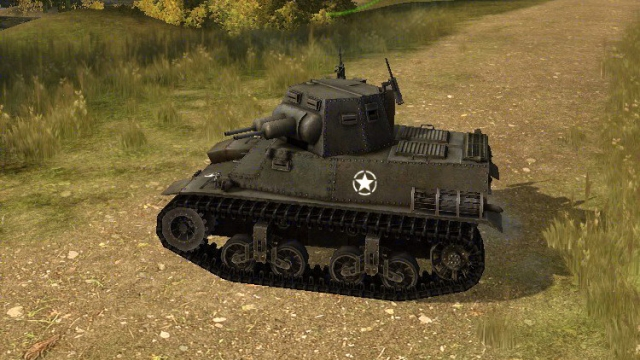 Manufactured by Marmon Herrington for the Dutch
military for colonial service, the contract was taken over and a
vehicle sent to Aberdeen “to determine the suitability of the 4-Man
Dutch Tank for military use by the Armed Forces of the United
States by subjecting the vehicle to certain features of the
standard test program. Since the Services of Supply had taken over
a contract from the Netherlands Purchasing Commission for 4-Man
Dutch Tanks, they were desirous to learn what branch of service
could use them” Maybe they should have asked first. Here’s the
official description of the vehicle. “The 4-Man Dutch Tank, Model
MTLS-1G14 built by the Marmon-Herrington Co, is a 42,000 pound,
full track laying vehicle powered by a six cylinder, liquid-cooled,
240 horsepower engine manufactured by the Hercules Motor
Corporation. The vehicle is a front drive employing a five-speed
transmission with a Marmon-Herrington controlled differential drive
with dual controls. The Marmon-Herrington all steel, 18 inch track
uses outside guides intergrally cast in the track blocks and the
suspension is a vertical volute spring type employing rubber-tired
bogie wheels. The hull is made of flat plates, bolted together,
varying from 1-1/2” thick on the front to ½” thick on the top. The
turret has a 360 degree traverse and it mounts two 37 mm/44 cal.
Automatic guns, one swivel mounted cal. .30 machine gun, and one
cal . .30 anti-aircraft machine gun mounted on the outside of the
turret. The auxiliary armament consists of three cal. .30 machine
guns placed in the bow of the vehicle. Two of the guns are in fixed
mounts, while the third is flexibly mounted.”
Manufactured by Marmon Herrington for the Dutch
military for colonial service, the contract was taken over and a
vehicle sent to Aberdeen “to determine the suitability of the 4-Man
Dutch Tank for military use by the Armed Forces of the United
States by subjecting the vehicle to certain features of the
standard test program. Since the Services of Supply had taken over
a contract from the Netherlands Purchasing Commission for 4-Man
Dutch Tanks, they were desirous to learn what branch of service
could use them” Maybe they should have asked first. Here’s the
official description of the vehicle. “The 4-Man Dutch Tank, Model
MTLS-1G14 built by the Marmon-Herrington Co, is a 42,000 pound,
full track laying vehicle powered by a six cylinder, liquid-cooled,
240 horsepower engine manufactured by the Hercules Motor
Corporation. The vehicle is a front drive employing a five-speed
transmission with a Marmon-Herrington controlled differential drive
with dual controls. The Marmon-Herrington all steel, 18 inch track
uses outside guides intergrally cast in the track blocks and the
suspension is a vertical volute spring type employing rubber-tired
bogie wheels. The hull is made of flat plates, bolted together,
varying from 1-1/2” thick on the front to ½” thick on the top. The
turret has a 360 degree traverse and it mounts two 37 mm/44 cal.
Automatic guns, one swivel mounted cal. .30 machine gun, and one
cal . .30 anti-aircraft machine gun mounted on the outside of the
turret. The auxiliary armament consists of three cal. .30 machine
guns placed in the bow of the vehicle. Two of the guns are in fixed
mounts, while the third is flexibly mounted.”  A tank showed up in Aberdeen with 2,400 miles on the
clock. After a brief mechanical inspection, it was sent out for
testing on hard surface roads. After twenty miles, differential oil
pressure had drop to zero and the oil was boiling. Upon inspection
it was found that both brake drums were cracked, the internal
pinions were rough, bearings worn, and brake bands burned. The
differential oil pump was disassembled and found to be worn out.
Instead of trying to repair this vehicle, Aberdeen just requested a
new tank. This one showed up about April 1943, and was driven 176
miles before the left rear idler wheel fell off. It was bolted back
on with new bolts, and got to mile 337 before the steering and
brakes stopped working. The brake drums were cracked and the brake
bands totally worn out. Aberdeen’s conclusion was that they had
basically taken a design from the lighter CTMS-1TBI, and it just
wasn’t up to the task. Routinely, track pins needed to be replaced
as the retaining rivets kept failing. The solution proposed was
identical to the solution used in T-34: Flip the tracks around so
that the head was on the inside, and install wedges on the hull
side to knock pins back into the track. The test was stopped before
this could be implemented, though.
A tank showed up in Aberdeen with 2,400 miles on the
clock. After a brief mechanical inspection, it was sent out for
testing on hard surface roads. After twenty miles, differential oil
pressure had drop to zero and the oil was boiling. Upon inspection
it was found that both brake drums were cracked, the internal
pinions were rough, bearings worn, and brake bands burned. The
differential oil pump was disassembled and found to be worn out.
Instead of trying to repair this vehicle, Aberdeen just requested a
new tank. This one showed up about April 1943, and was driven 176
miles before the left rear idler wheel fell off. It was bolted back
on with new bolts, and got to mile 337 before the steering and
brakes stopped working. The brake drums were cracked and the brake
bands totally worn out. Aberdeen’s conclusion was that they had
basically taken a design from the lighter CTMS-1TBI, and it just
wasn’t up to the task. Routinely, track pins needed to be replaced
as the retaining rivets kept failing. The solution proposed was
identical to the solution used in T-34: Flip the tracks around so
that the head was on the inside, and install wedges on the hull
side to knock pins back into the track. The test was stopped before
this could be implemented, though.  This was probably a relief to the driver. To get the
vehicle to turn at its minimum diameter of 46’3”, the driver had to
pull back on the short steering lever with a force of 100lbs.
Aberdeen fashioned some extensions, this dropped the requirement to
a mere 60lbs. However, the vehicle was still considered tiring to
drive because of the cramped quarters, small vision ports, and
short gear shift lever. Over the sand course, the vehicle was
“exceptionally slow and sluggish.” The engine just wasn’t powerful
enough. The M3A1 light tank had about the same horsepower, while
being about seven tons lighter. The MTLS could conduct a steady
turn only in 1st gear, and it couldn’t go any faster in a
straight line than 10mph in 3rd gear.
This was probably a relief to the driver. To get the
vehicle to turn at its minimum diameter of 46’3”, the driver had to
pull back on the short steering lever with a force of 100lbs.
Aberdeen fashioned some extensions, this dropped the requirement to
a mere 60lbs. However, the vehicle was still considered tiring to
drive because of the cramped quarters, small vision ports, and
short gear shift lever. Over the sand course, the vehicle was
“exceptionally slow and sluggish.” The engine just wasn’t powerful
enough. The M3A1 light tank had about the same horsepower, while
being about seven tons lighter. The MTLS could conduct a steady
turn only in 1st gear, and it couldn’t go any faster in a
straight line than 10mph in 3rd gear.  There were some good points. It could negotiate a 24”
wall forwards or backwards, and could ford 48” of water with no
leaks. Yay. Of course, such things are mere technicalities. What’s
important is the firepower! Well… “The armament on this vehicle is
unsatisfactory from a standpoint of accuracy, maintenance and
interchangeability. The major weapons are two 37mm/44 cal. Guns
mounted coaxially in the turret and manufactured by the American
Armament Corporation. They are semi-automatic weapons which fire
five rounds from a circular clip, and these guns will not
accommodate the standard 37mm ammunition which would create a
complex supply problem. When conducting firing tests on these guns,
it was found that the rammers of both guns were so badly worn out
that they would not load and fire automatically. One gun could be
fired when manually loaded, but the other one could not because the
spring in the ejector mechanism was missing. The guns are not
provided with stabilisers and the unstable firing platform would
render their fire highly inaccurate during vehicle operation, also
due to their complex structure, they require a kit of special tools
for maintenance. The minor armament consists of five cal .30 Colt
air cooled machine guns which are not interchangeable with the cal.
.30 M1919A4 machine gun used on standard combat vehicles. Three of
these guns are located in the bow of the vehicle while the other
two are in the turret. Even though, when proof-fired, the cal. .30
Colt functioned satisfactorily, its effectiveness in battle would
be greatly impaired by the small amount of flexibility of the gun
mount and the inadequate size of the vision ports.” That was the
theory. In practice, “it was impossible to install a machine gun in
any of the machine gun mountings, either because the trunnion
holes of the guns would not match with the holes of the mountings,
or the openings for the gun barrel shields were too small. The left
37mm gun could not be fired; it appeared that the rear trip spring
was not functioning. Because of this it was necessary to release
the sear by inserting a screw driver through the side of the
cradle. After much adjusting, the right gun was put in a
satisfactory condition for firing”. The turret had power traverse,
manual elevation.
There were some good points. It could negotiate a 24”
wall forwards or backwards, and could ford 48” of water with no
leaks. Yay. Of course, such things are mere technicalities. What’s
important is the firepower! Well… “The armament on this vehicle is
unsatisfactory from a standpoint of accuracy, maintenance and
interchangeability. The major weapons are two 37mm/44 cal. Guns
mounted coaxially in the turret and manufactured by the American
Armament Corporation. They are semi-automatic weapons which fire
five rounds from a circular clip, and these guns will not
accommodate the standard 37mm ammunition which would create a
complex supply problem. When conducting firing tests on these guns,
it was found that the rammers of both guns were so badly worn out
that they would not load and fire automatically. One gun could be
fired when manually loaded, but the other one could not because the
spring in the ejector mechanism was missing. The guns are not
provided with stabilisers and the unstable firing platform would
render their fire highly inaccurate during vehicle operation, also
due to their complex structure, they require a kit of special tools
for maintenance. The minor armament consists of five cal .30 Colt
air cooled machine guns which are not interchangeable with the cal.
.30 M1919A4 machine gun used on standard combat vehicles. Three of
these guns are located in the bow of the vehicle while the other
two are in the turret. Even though, when proof-fired, the cal. .30
Colt functioned satisfactorily, its effectiveness in battle would
be greatly impaired by the small amount of flexibility of the gun
mount and the inadequate size of the vision ports.” That was the
theory. In practice, “it was impossible to install a machine gun in
any of the machine gun mountings, either because the trunnion
holes of the guns would not match with the holes of the mountings,
or the openings for the gun barrel shields were too small. The left
37mm gun could not be fired; it appeared that the rear trip spring
was not functioning. Because of this it was necessary to release
the sear by inserting a screw driver through the side of the
cradle. After much adjusting, the right gun was put in a
satisfactory condition for firing”. The turret had power traverse,
manual elevation.  By 02NOV1943, Aberdeen decided they had better things
to do with their time than to continue mucking about with this
vehicle, and both firing and automotive tests were stopped. They
did take the time to note, however, that “The hull is ballistically
unsatisfactory, since it employs flat, bolted plates that are
practically vertical”. Overall, then, the report concluded… “The
vehicle is thoroughly unreliable, mechanically and structurally
unsound, underpowered and equipped with unsatisfactory armament.
The 4-Man Dutch Tank Model MTLS-1G14 is not a satisfactory combat
vehicle for any branch of the Armed Forces” Actually, I think it’s
the most scathing conclusion I’ve ever seen come from Aberdeen.
For those of you who don't know, I've a Facebook
page here , and once in a blue moon, I stream
at http://www.twitch.tv/the_chieftain
By 02NOV1943, Aberdeen decided they had better things
to do with their time than to continue mucking about with this
vehicle, and both firing and automotive tests were stopped. They
did take the time to note, however, that “The hull is ballistically
unsatisfactory, since it employs flat, bolted plates that are
practically vertical”. Overall, then, the report concluded… “The
vehicle is thoroughly unreliable, mechanically and structurally
unsound, underpowered and equipped with unsatisfactory armament.
The 4-Man Dutch Tank Model MTLS-1G14 is not a satisfactory combat
vehicle for any branch of the Armed Forces” Actually, I think it’s
the most scathing conclusion I’ve ever seen come from Aberdeen.
For those of you who don't know, I've a Facebook
page here , and once in a blue moon, I stream
at http://www.twitch.tv/the_chieftain
On rare occasions, you will hear talk of some
mythical, low-tier monster, which shoots flames out of both
nostrils, melting all before it. That’s the MTLS-1G14. Not a common
vehicle in the game. Manufactured by Marmon Herrington for the Dutch
military for colonial service, the contract was taken over and a
vehicle sent to Aberdeen “to determine the suitability of the 4-Man
Dutch Tank for military use by the Armed Forces of the United
States by subjecting the vehicle to certain features of the
standard test program. Since the Services of Supply had taken over
a contract from the Netherlands Purchasing Commission for 4-Man
Dutch Tanks, they were desirous to learn what branch of service
could use them” Maybe they should have asked first. Here’s the
official description of the vehicle. “The 4-Man Dutch Tank, Model
MTLS-1G14 built by the Marmon-Herrington Co, is a 42,000 pound,
full track laying vehicle powered by a six cylinder, liquid-cooled,
240 horsepower engine manufactured by the Hercules Motor
Corporation. The vehicle is a front drive employing a five-speed
transmission with a Marmon-Herrington controlled differential drive
with dual controls. The Marmon-Herrington all steel, 18 inch track
uses outside guides intergrally cast in the track blocks and the
suspension is a vertical volute spring type employing rubber-tired
bogie wheels. The hull is made of flat plates, bolted together,
varying from 1-1/2” thick on the front to ½” thick on the top. The
turret has a 360 degree traverse and it mounts two 37 mm/44 cal.
Automatic guns, one swivel mounted cal. .30 machine gun, and one
cal . .30 anti-aircraft machine gun mounted on the outside of the
turret. The auxiliary armament consists of three cal. .30 machine
guns placed in the bow of the vehicle. Two of the guns are in fixed
mounts, while the third is flexibly mounted.” A tank showed up in Aberdeen with 2,400 miles on the
clock. After a brief mechanical inspection, it was sent out for
testing on hard surface roads. After twenty miles, differential oil
pressure had drop to zero and the oil was boiling. Upon inspection
it was found that both brake drums were cracked, the internal
pinions were rough, bearings worn, and brake bands burned. The
differential oil pump was disassembled and found to be worn out.
Instead of trying to repair this vehicle, Aberdeen just requested a
new tank. This one showed up about April 1943, and was driven 176
miles before the left rear idler wheel fell off. It was bolted back
on with new bolts, and got to mile 337 before the steering and
brakes stopped working. The brake drums were cracked and the brake
bands totally worn out. Aberdeen’s conclusion was that they had
basically taken a design from the lighter CTMS-1TBI, and it just
wasn’t up to the task. Routinely, track pins needed to be replaced
as the retaining rivets kept failing. The solution proposed was
identical to the solution used in T-34: Flip the tracks around so
that the head was on the inside, and install wedges on the hull
side to knock pins back into the track. The test was stopped before
this could be implemented, though. This was probably a relief to the driver. To get the
vehicle to turn at its minimum diameter of 46’3”, the driver had to
pull back on the short steering lever with a force of 100lbs.
Aberdeen fashioned some extensions, this dropped the requirement to
a mere 60lbs. However, the vehicle was still considered tiring to
drive because of the cramped quarters, small vision ports, and
short gear shift lever. Over the sand course, the vehicle was
“exceptionally slow and sluggish.” The engine just wasn’t powerful
enough. The M3A1 light tank had about the same horsepower, while
being about seven tons lighter. The MTLS could conduct a steady
turn only in 1st gear, and it couldn’t go any faster in a
straight line than 10mph in 3rd gear. There were some good points. It could negotiate a 24”
wall forwards or backwards, and could ford 48” of water with no
leaks. Yay. Of course, such things are mere technicalities. What’s
important is the firepower! Well… “The armament on this vehicle is
unsatisfactory from a standpoint of accuracy, maintenance and
interchangeability. The major weapons are two 37mm/44 cal. Guns
mounted coaxially in the turret and manufactured by the American
Armament Corporation. They are semi-automatic weapons which fire
five rounds from a circular clip, and these guns will not
accommodate the standard 37mm ammunition which would create a
complex supply problem. When conducting firing tests on these guns,
it was found that the rammers of both guns were so badly worn out
that they would not load and fire automatically. One gun could be
fired when manually loaded, but the other one could not because the
spring in the ejector mechanism was missing. The guns are not
provided with stabilisers and the unstable firing platform would
render their fire highly inaccurate during vehicle operation, also
due to their complex structure, they require a kit of special tools
for maintenance. The minor armament consists of five cal .30 Colt
air cooled machine guns which are not interchangeable with the cal.
.30 M1919A4 machine gun used on standard combat vehicles. Three of
these guns are located in the bow of the vehicle while the other
two are in the turret. Even though, when proof-fired, the cal. .30
Colt functioned satisfactorily, its effectiveness in battle would
be greatly impaired by the small amount of flexibility of the gun
mount and the inadequate size of the vision ports.” That was the
theory. In practice, “it was impossible to install a machine gun in
any of the machine gun mountings, either because the trunnion
holes of the guns would not match with the holes of the mountings,
or the openings for the gun barrel shields were too small. The left
37mm gun could not be fired; it appeared that the rear trip spring
was not functioning. Because of this it was necessary to release
the sear by inserting a screw driver through the side of the
cradle. After much adjusting, the right gun was put in a
satisfactory condition for firing”. The turret had power traverse,
manual elevation. By 02NOV1943, Aberdeen decided they had better things
to do with their time than to continue mucking about with this
vehicle, and both firing and automotive tests were stopped. They
did take the time to note, however, that “The hull is ballistically
unsatisfactory, since it employs flat, bolted plates that are
practically vertical”. Overall, then, the report concluded… “The
vehicle is thoroughly unreliable, mechanically and structurally
unsound, underpowered and equipped with unsatisfactory armament.
The 4-Man Dutch Tank Model MTLS-1G14 is not a satisfactory combat
vehicle for any branch of the Armed Forces” Actually, I think it’s
the most scathing conclusion I’ve ever seen come from Aberdeen.
For those of you who don't know, I've a Facebook
page here , and once in a blue moon, I stream
at http://www.twitch.tv/the_chieftainMTLS-1G14